Researchers at Unicamp have developed an innovative, safe, and cylindrical flow battery that uses domestic materials to optimize large-scale solar and wind energy storage, reducing leak risks and dependence on diesel generators.
The transition to cleaner energy matrices faces a historic hurdle: intermittency. While sun and wind are abundant, they are also unpredictable, requiring efficient solutions to store excess electricity. To address this bottleneck, scientists at the School of Electrical and Computer Engineering (FEEC) at Unicamp, affiliated with the Brazilian Renewable Energies (BREnergies) group, have created a new flow battery architecture aimed at making energy storage cheaper, simpler, and safer.
This technological breakthrough promises to transform how we handle the intermittency of solar energy and wind energy farms. Initially developed during the doctoral research of João Pedro Aguiar dos Santos, under the guidance of Professor César Pagan and co-advisement of Professor Hudson Zanin, the innovation features a revolutionary design that eliminates the primary failure points found in current market technologies.
A new format to solve old problems
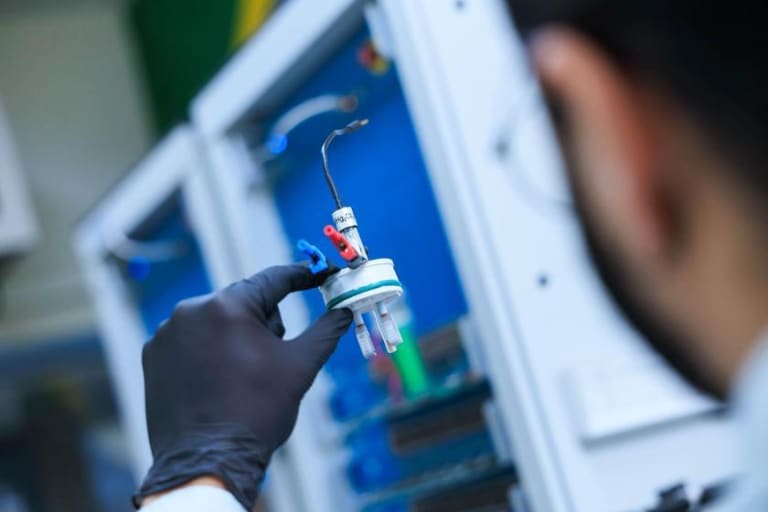
Traditional flow batteries resemble stacked plates connected by external hoses, an arrangement susceptible to leaks and the formation of dendrites that cause short circuits. To overcome these obstacles, the Unicamp team completely redesigned the system, adopting a strictly cylindrical structure where the electrolyte circulates internally via a small turbine, eliminating fragile piping and minimizing operational risks.
“During my studies, I realized there was no design or experimental setup available for purchase to build the battery. This was a major challenge because we had to assemble everything from the cells to the larger reactors to conduct the laboratory experiments,” explains João Pedro Aguiar dos Santos.
Superior performance and innovation in lab tests
In rigorous practical laboratory tests, the technology achieved approximately 400 cycles without chemical additives, surpassing the 100-cycle average observed in conventional systems under identical conditions. Furthermore, it reached an excellent energy efficiency of 82%, accompanied by an impressive 98% charge efficiency, steadily powering LED lights and fans during hours of continuous experimental operation.
Durability is also boosted by the use of methanesulfonic acid (MSA), a biodegradable and less toxic compound that replaces conventional sulfuric acid. Combined with an intelligent software monitoring system, the project mitigates operational risks and projects an estimated lifespan of up to two decades for the stationary unit.
Domestic materials and sustainability in the supply chain
Another major competitive edge lies in the choice of materials used in manufacturing. The technology was designed to utilize materials widely available in Brazil, such as graphite and non-flammable aqueous electrolytes. The researchers used a version based on dissolved lead ions, integrating perfectly with the national recycling chain, which already recovers over 98% of this material with high efficiency.
Unlike traditional lead-acid batteries—whose solid electrodes suffer significant degradation—in this model, the electrodes are inert and made of graphite, while the active component remains dissolved in the liquid. This ensures that the system recovers its full capacity after a simple replacement of the degraded electrolyte, significantly extending the equipment’s lifecycle.
Impact on clean energy expansion
Designed specifically for stationary storage, the innovation arrives at an opportune moment to integrate with BESS (Battery Energy Storage Systems) connected to renewable power plants. The technology serves as a strategic tool to mitigate curtailment—the forced reduction of power plant generation due to transmission grid saturation—and to gradually replace polluting diesel generators in isolated locations.
With a patent application filed with the INPI through the Inova Unicamp Innovation Agency, the project now awaits interest from the private sector for licensing. This advancement represents a definitive step toward consolidating Brazil as a technology hub for developing self-sustaining solutions for the future of the electric power sector.