
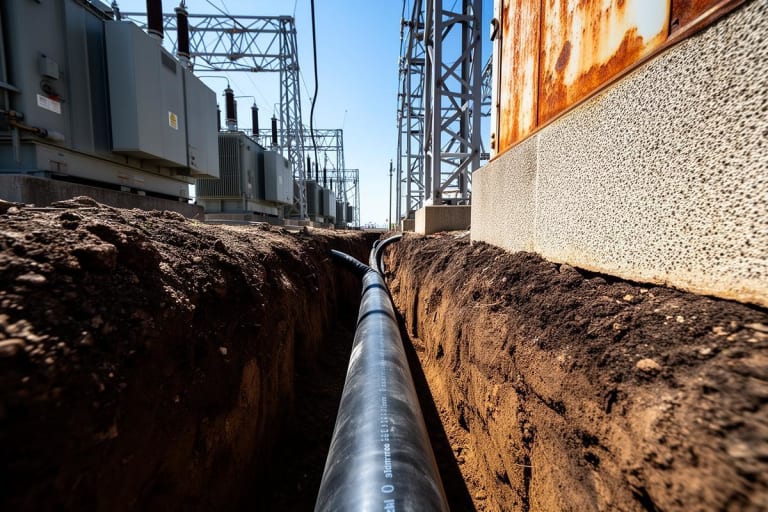
A Leap Forward in Brazilian Energy Infrastructure: Assis (SP) Inaugurates the First 525 kV Underground Cable.
Brazil’s energy transmission landscape has reached a historic milestone with the inauguration of the country’s first 525 kV underground cable at the Assis substation, located in rural São Paulo. This technological innovation, implemented by Taesa (Transmissora Aliança de Energia Elétrica S.A.), not only fortifies the region’s clean energy system but also showcases pioneering solutions for energy infrastructure challenges.
The adoption of underground cables, as opposed to traditional overhead lines typically supported by towers, serves as a strategic response to the physical space limitations at the Assis substation. This Taesa initiative not only optimizes land utilization but also paves the way for new technical possibilities in critical installations of the National Interconnected System (SIN), particularly in geographically complex or expansion-restricted areas.
Strategic Reinforcement for the SIN
The installation of these high-voltage cables is a key component of the Ananaí project, awarded to Taesa by the National Electric Energy Agency (Aneel). The project, slated for operation until 2052, aims to enhance the connection between Paraná and São Paulo, spanning approximately 284 km.
It’s important to note that the transmission line itself is not entirely underground; the innovative buried cable solution focuses on specific sections within the Assis substation, connecting crucial equipment.
Jell Lima de Andrade, speaking at a press event at the substation on September 3, 2026, underscored the strategic importance of Assis. He highlighted that the location has become a vital hub for dispatching energy generated in regions such as Brazil’s North and Northeast.
He stated:
The energy redirection targets consumption centers in São Paulo and, subsequently, the South of the country, extending to the metropolitan region of Curitiba.
Expanded Energy Exchange and Impact on Consumption
The modernization of the Assis substation, featuring the 525 kV underground cable, has a direct and significant impact on the energy exchange capacity between the states of São Paulo and Paraná. The new infrastructure is estimated to boost this flow by an impressive 2 GW (gigawatts).
This expansion translates to greater flexibility for the national electrical system, enabling larger volumes of electricity to be transferred between regions, in accordance with fluctuations in generation and demand.
To gauge the magnitude of this increase, it’s estimated that if the additional capacity were fully utilized for one month, it would be sufficient to supply approximately 8.3 million Brazilian households. This calculation is based on an average monthly per capita energy consumption of about 174 kWh, according to data consolidated by the Energy Research Company (EPE) in July 2026.
This new capacity reinforces the robustness and interconnection of the National Interconnected System (SIN), enabling a more dynamic energy flow adaptable to the country’s needs.
Technology and Specifications of Underground Cables
Taesa installed a total of six underground cable sections for the substation’s new configuration. Three sections, each approximately 590 meters long, are responsible for connecting the autotransformer bank to the 525 kV sector. The other three sections, about 200 meters each, connect the reserve unit, which operates at both 525 kV and 440 kV.
In total, approximately 2.36 km of cables were installed, with each meter weighing around 41.1 kg. The installation was meticulously planned, with the bottom of the cables positioned about 1.1 meters from the conduit’s surface.
The unit of measure ‘kV’, or kilovolt, indicates electrical voltage, which is crucial for the efficient transmission of large volumes of electricity over long distances with minimized losses. The cables in Assis, operating at 525 kV, connect directly to the substation’s high-voltage sector. Manufactured from copper and insulated with XLPE (cross-linked polyethylene), these cables have an external diameter of 156.2 mm and were designed to withstand the demanding operational conditions of the autotransformer bank.
Autotransformers and Revenue Generation
Complementing the cable infrastructure, the Assis project also involved the installation of a 1,500 MVA (megavolt-ampere) autotransformer bank. These pieces of equipment are essential for adjusting voltage levels in different phases of the transmission system, operating under normal and emergency conditions with currents up to 2,566 A at 525 kV.
High-voltage transmission capacity is crucial for large-scale energy efficiency. With operations commencing on July 27, 2026, the Assis project represents an increase of approximately R$ 173 million to Taesa‘s Annual Allowed Revenue (RAP).
RAP is the remuneration model for transmission companies, based on the availability of infrastructure for the electrical system. It is paid by network users and reflected in energy tariffs. This value is tied to the infrastructure’s availability, regardless of the volume of energy actually transmitted.