
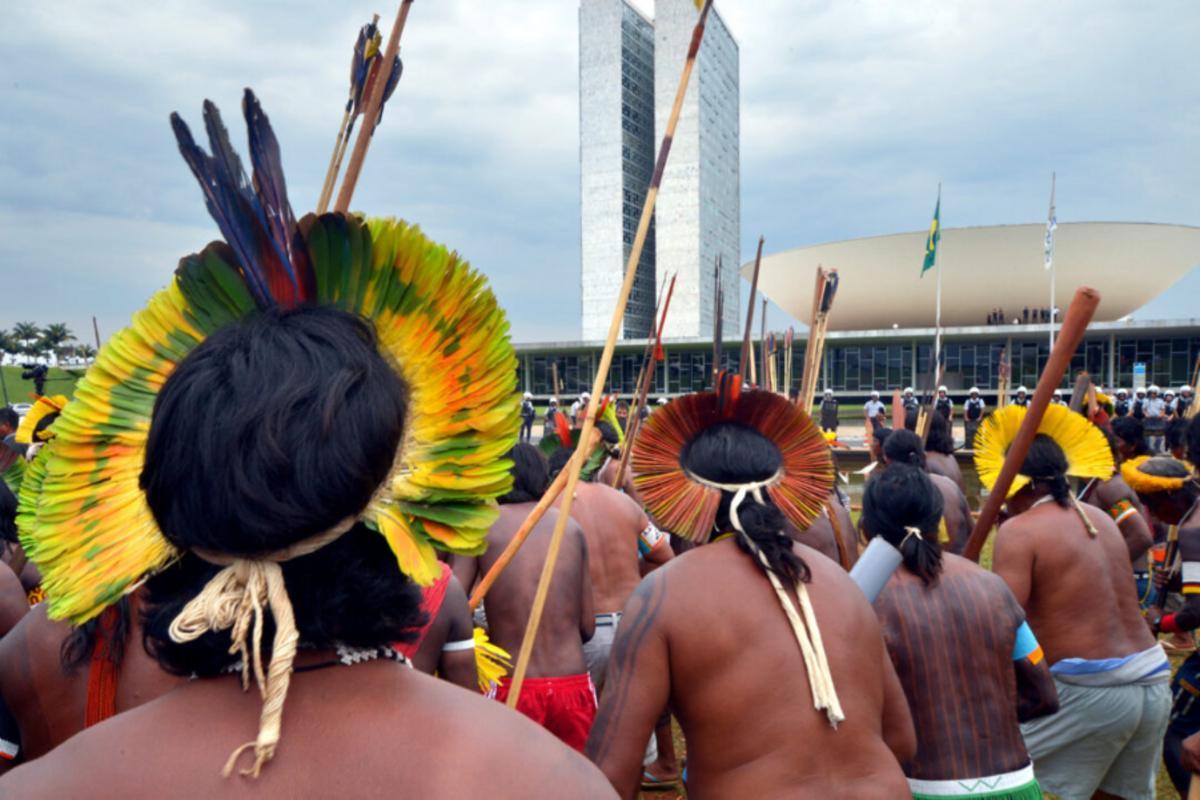
The APIB sent a letter to President Luiz Inácio Lula da Silva demanding the demarcation of lands for 73 Indigenous Territories by 2026 and actions against violence, reinforcing environmental preservation amid the climate crisis.
The Articulation of Indigenous Peoples of Brazil (APIB), together with its seven regional organizations, sent a formal letter to President Luiz Inácio Lula da Silva outlining priority proposals for the end of the current term and the direction of public policies in the coming years.
The document highlights the urgent need to curb the escalation of violence in the territories and accelerate land regularization across the country.
The initiative places environmental preservation and the guarantee of original rights at the center of the debate about the nation’s future.
For the leaders, protecting ecosystems preserved by indigenous peoples is an indispensable pillar for ensuring sustainability and Brazil’s socio‑environmental balance amid the global landscape of environmental change.
Beyond immediate protection measures, the indigenous movement calls for direct and effective participation in shaping governmental pathways, arguing that environmental and territorial governance should be built together with the communities that live in and protect the forests.
Territorial demarcation and climate crisis mitigation
Among the main demands presented in the letter is progress in the regularization processes for 73 already declared Indigenous Territories.
The APIB requests that the federal government adopt concrete measures by 2026 to finalize the approval of these areas, cementing a historic legacy for the country’s environmental management.
This demand is framed as a living tribute to chief Raoni Metuktire and several elders who have devoted their lives to defending the forests.
The organization reaffirms its goal of achieving full demarcation of all territories by 2030, directly linking land protection to national strategies to combat the climate emergency.
In response to warnings about extreme weather events such as the El Niño phenomenon, the entity stresses that keeping territories protected is the most effective response against deforestation.
This conservation model should also extend to quilombola communities, Conservation Units, and sustainable settlements.
Protection against violence in territories
The survey conducted by APIB identified more than 30 reports of violence against indigenous communities during the 2026 election period.
The situation is considered critical among the Guarani and Kaiowá peoples, who face ongoing murders and threats reported after the vote.
The complaints have already been formalized with the Federal Public Ministry (MPF) and executive branch agencies.
In the message delivered to President Lula, the organization demands a thorough investigation of the crimes and the immediate deployment of security forces to ensure the physical safety of the threatened communities.
Ecological transition without predatory mining
Another central point of the document is the defense that Indigenous Lands remain entirely free of mining activities, including the extraction of critical and strategic minerals often linked to the energy transition.
The movement argues that true ecological transition cannot occur at the expense of degrading traditional territories.
APIB also expressed deep concern about legislative initiatives in the National Congress, highlighting the risks posed by proposals such as the time‑frame.
The movement calls for a firm stance from the executive branch to block legal setbacks and ensure compliance with environmental and constitutional standards.
Through the project Our Territory, Our Life, the coalition presents a sovereign proposal for sustainable development in Brazil, grounded in responsible management and biodiversity conservation.
The APIB stated:
For us, Brazilian sovereignty is deeply tied to the protection of Indigenous territories.
With the delivery of the document, the APIB awaits scheduling an official meeting with President Lula to structure the Indigenous movement’s presence in the government’s decision‑making bodies.
Advances in land demarcation and the strengthening of environmental policies are seen as decisive steps for Brazil to consolidate its global leadership in sustainability and socio‑environmental justice in the coming years.