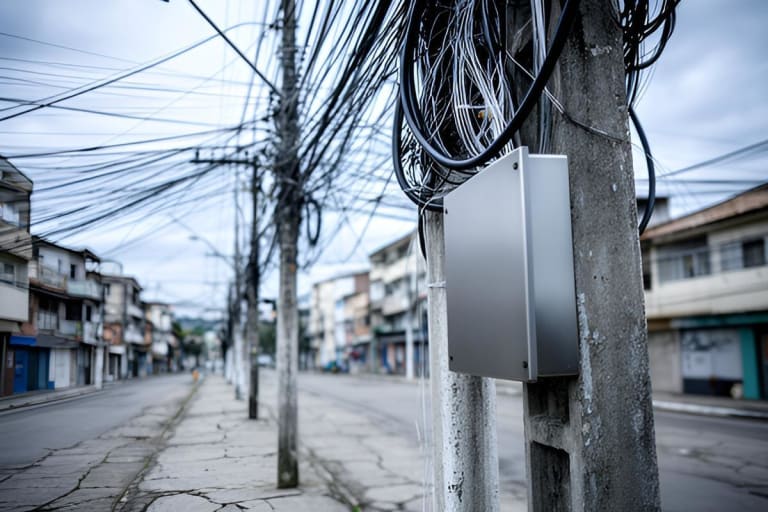
Aneel has opted to delay its decision on the utility pole leasing model to ensure alignment with Anatel, aiming to resolve conflicts regarding the involvement of economic groups.
The quest for unified governance regarding the commercial use of utility poles in Brazil has reached a new chapter. On Tuesday, the National Electric Energy Agency (Aneel) decided to remove the vote on regulations governing the mandatory transfer of these assets to third-party companies from its agenda. The primary goal is to synchronize efforts with the National Telecommunications Agency (Anatel) before moving forward with a final draft.
The impasse stems from a strategic divergence: the draft approved by Anatel prohibits companies belonging to the same economic group as the power distributor from participating in public tenders for pole use. However, some Aneel directors have questioned the necessity of this restriction, arguing there is no robust evidence to justify preventing utility subsidiaries from competing in this market.
Institutional consensus as a priority
The need for a harmonious decision between the two agencies became even more critical following a binding opinion from the Office of the Attorney General of the Union (AGU), which confirmed the mandatory nature of commercial cession to an entity separate from the distributor, as provided for in Decree 12.068/2024. To prevent the two regulatory bodies from issuing conflicting rules, the rapporteur of the process at Aneel, Gentil Nogueira, has proposed a 15-day period for institutional dialogue.
The rapporteur stated:
“The intention is to seek an understanding before a new deliberation and avoid having the two agencies approve different texts on the same model.”
This reinforces the cautious technical approach adopted by the board of directors.
Governance and next steps
Beyond the dispute over the profile of future operators, the regulation faces the challenge of designing a model that is both efficient and attractive. There is a latent concern that the market might focus solely on high-profit zones, neglecting less affluent areas. Consequently, the agencies plan to define operating areas that combine different profiles of economic attractiveness.
Meanwhile, the Brazilian Association of Electric Power Distributors (Abradee) is keeping a close eye on the process, calling for greater clarity regarding remuneration and responsibilities during the transition of contracts. Aneel, for its part, emphasizes that oversight of current pole occupation activities remains ongoing, focusing on regularizing the infrastructure that supports both the distribution network and telecommunications services. The sector’s expectation is that, following the round of discussions between the boards, the final rules will provide the legal certainty necessary to unlock investments in the industry.