
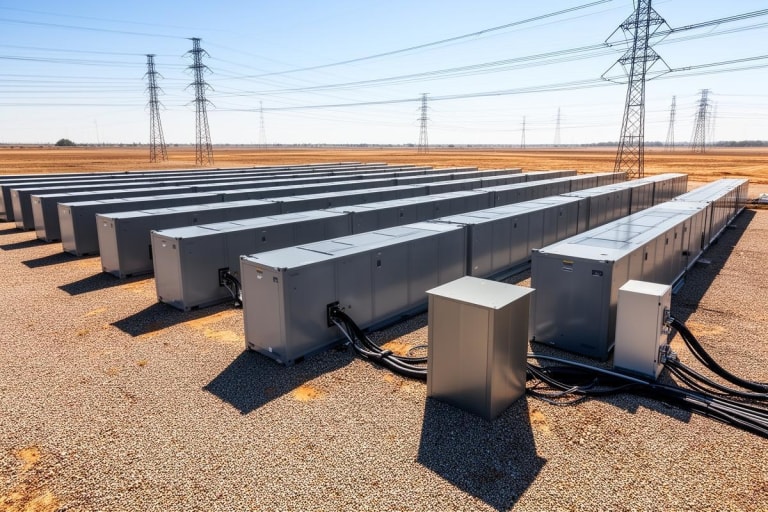
The National Electric Energy Agency (Aneel) is detailing how the costs of batteries from Capacity Reserve Auctions (LRCap) will be passed on to consumers, sparking debates over who will bear the charge and its distribution.
The National Electric Energy Agency (Aneel) has just released a proposal that promises to reshape how energy costs are distributed across the country.
A draft resolution, prepared by the agency’s technicians, outlines the mechanism for passing on the charge for batteries, contracted in upcoming Capacity Reserve Auctions (LRCap) scheduled for December, directly to buyers of existing regulated contracts. This move aims for clarity but is already igniting intense discussions within the electric sector.
The core of the proposal is the formalization of how the cost of these energy storage technologies will be incorporated into the tariff structure. The draft not only lists the impacted contracts but also establishes a general formula for this cost transfer.
It also grants the Electric Energy Commercialization Chamber (CCEE) a 180-day period to create detailed operational rules, a crucial step for the practical implementation of the measure.
Pass-Through Details and Calculation Basis
In parallel to the draft resolution, a complementary technical note from the Superintendence of Regulation of Generation Services and the Electric Energy Market (SGM), dated September 8, confirmed the previously presented billing model. However, it added the necessary guidelines for its effective operationalization. The document delves into the calculation basis for the charge, the segregation of financial flows, and the responsibilities of the CCEE and the National Electric System Operator (ONS).
Since the initial disclosure of the Regulatory Impact Analysis (AIR) and the proposal on August 24, Aneel has received a series of questions. The main queries revolve around who will ultimately pay the charge and how this cost distribution will occur. The legal review is still pending regarding the situation of self-producers of energy and the possible inclusion of micro and distributed mini-generation (MMGD) among the contributors.
Battery Costs: Who Pays the Bill?
Law 15.269/2025 had stipulated that battery costs would be exclusively shared among generators.
However, the AIR considered that this formal assignment does not prevent the application of cost recovery clauses for regulated contracts entered into before the charge was created.
The draft resolution proposes that the charge be passed on to buyers of current regulated contracts with cost recovery mechanisms, covering a range of instruments such as CCEARs, CERs, CRCaps, Itaipu, Angra 1 and Angra 2 contracts, Proinfa, and physical guarantee and capacity quota contracts.
The pass-through calculation will be done using a Contractual Commitment Factor, which will represent the portion of the charge associated with the energy allocated in regulated instruments. Although the draft presents the general formula, the details of this factor will be referred to the Commercialization Rules, with the CCEE having 180 days after the resolution’s publication to develop the operational routines.
The same model would allow reproducing the economic effect of cost recovery without individually altering contract prices. The report states that the cost initially borne by the generator would be transferred to the regulated buyer and, through tariffs, to captive consumers.
Aneel has not yet estimated the exact portion of the charge that will be passed on, but the AIR indicated that the Regulated Contracting Environment (ACR) represented 39,678 MW on average in June 2026, equivalent to 56.6% of the CCEE‘s consumption. It is important to note that this rule does not apply to free market contracts, where any readjustments will depend on the specific clauses of each contract and dispute resolution mechanisms.
Intense Debate on Self-Producers and Distributed Generation
The discussion about who pays has intensified, especially concerning self-producers.
The SGM consulted the Federal Attorney’s Office at Aneel on whether self-producers can be considered generators for paying the charge and, if so, on what calculation basis (total production or only the portion exported to the grid) the charge would apply.
The draft defines the charge payer as the holder of a generation unit’s concession or registration who is a CCEE agent, but with no clarity on how this applies to different self-production models.
Associations such as the Brazilian Association of Investors in Self-Production of Energy (Abiape), Axia Energia, and Engie have already met with the attorney’s office to present their interpretations, with divergent views on the inclusion and scope of the charge for self-producers.
Apine (Brazilian Association of Independent Electric Power Producers) went further, requesting the Attorney’s Office to assess the inclusion of MMGD “consumer-generators,” who are currently outside the calculation basis, arguing for an asymmetry compared to centralized solar generation.
Allocation by Flexibility and Next Steps
The draft maintains the alternative proposed by the SGM in August, which foresees all generators participating in the charge allocation, with a gradation based on each project’s flexibility.
The power plants would be classified into four tiers (100%, 75%, 50%, and 25% of the unit value), based on the energy associated with the generation agent.
The ONS will be responsible for classifying the power plants annually, with the classification being valid for the following year. This approach aims to recognize the differences in services provided by power plants and batteries, especially the bidirectional capacity of storage systems.
The draft also foresees the creation of separate accounts, guarantees, and settlement processes for batteries and conventional capacity reserve.
The text and the AIR will be submitted to a 30-day public consultation, a fundamental step to gather contributions and shape the final regulation.
The process is under the rapporteurship of director Gentil Nogueira and awaits deliberation by the Aneel board.
The agency’s final decision will have a significant impact on the electric sector’s cost structure and, consequently, on Brazilian consumers’ energy bills, requiring attention and monitoring from all stakeholders interested in the future of clean and sustainable energy in the country.