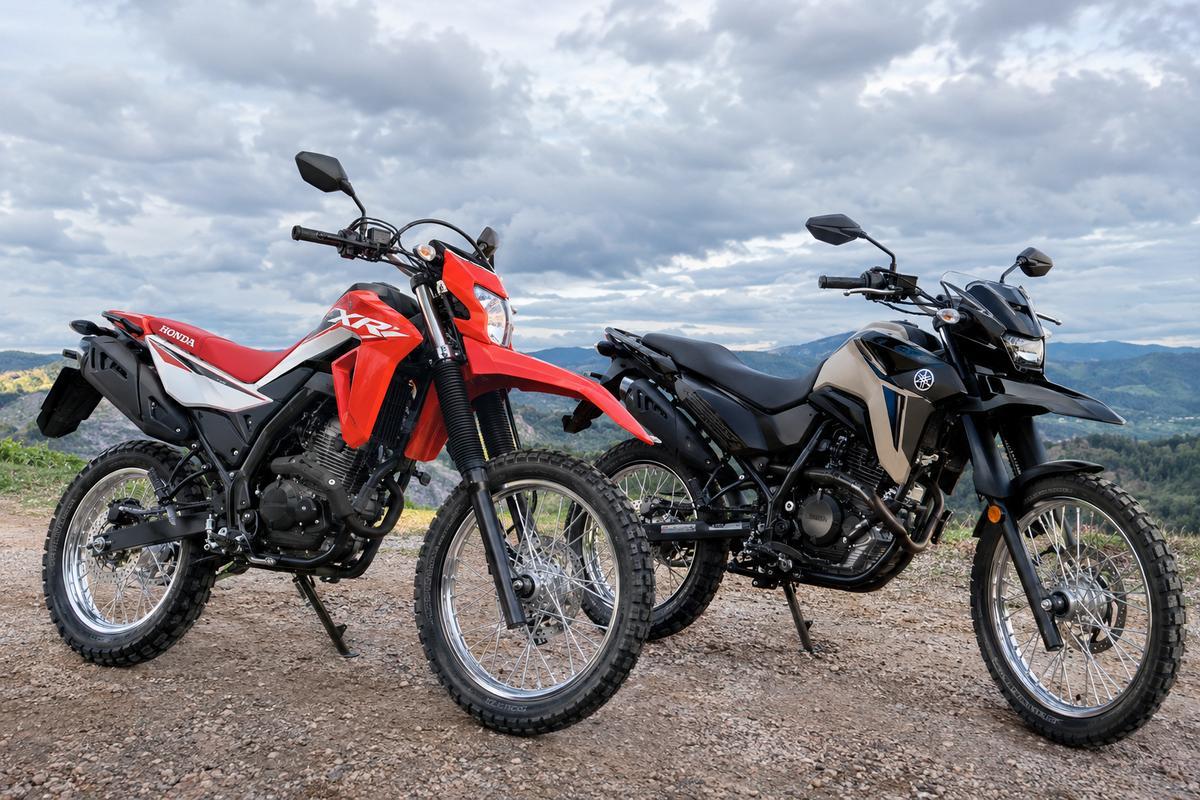
The Yamaha Lander maintains a striking dominance in sales over the Honda Tornado 300, showing that factors such as economy, price, and brand trust weigh as heavily as raw performance.
The rivalry between the Yamaha Lander Connected and the Honda XR 300L Tornado has revealed an absolute truth about Brazil’s two‑wheel market: the average consumer prioritizes cost‑effectiveness and urban versatility over the technical allure of off‑road adventures.
Although the new Tornado arrives on the market with modern technologies and superior powertrain, the Lander remains sovereign on Brazilian streets, accumulating registration numbers that exceed almost three times the sales volume of its direct rival.
Between January and October 2026, Yamaha registered 34,814 units of the Lander, while Honda recorded 11,980 sales of its Tornado.
This 191% advantage places the Japanese brand’s motorcycle in fourth place among the country’s best‑selling trails, reinforcing that in the entry‑level and mixed‑use segment, the owner’s wallet and mechanical reliability are often the decisive factors at purchase time.
The economic factor in the consumer’s balance sheet
One of the pillars supporting the preference for the Yamaha Lander is the acquisition cost. With a suggested price of R$ 29,490, the Lander is R$ 2,210 cheaper than the Honda Tornado 300, which starts at R$ 31,700.
For the Brazilian who uses the motorcycle as a work tool or daily transport, this difference reflects not only in financing but also in long‑term value perception, including maintenance costs and replacement part prices.
Beyond the sticker price, the Lander’s fuel efficiency is a hard‑to‑ignore argument. With an average of 39.4 km/l in urban conditions, the Yamaha trail delivers a range that approaches 535 kilometers.
In a landscape of constant fuel price fluctuations, this annual savings—potentially exceeding R$ 800 for those who ride 15,000 kilometers—solidifies the motorcycle as a budget ally.
Performance versus Rational Use
The Honda has opted for a high‑performance configuration for the new Tornado. Equipped with a 293.5‑cc engine capable of running on ethanol, delivering 24.8 hp and a six‑speed gearbox, the motorcycle offers quicker acceleration and greater capability on uneven terrain.
The inclusion of technologies such as HSTC traction control and ABS on both wheels raises Honda’s safety benchmark.
Automotive market analysts stated:
The mechanical superiority of the Tornado favors more demanding routes, where torque delivery and suspension travel make a real difference off‑road.
However, Yamaha compensates for its smaller displacement (249 cc) with a focus on comfort and connectivity. The digital dashboard with smartphone integration via the Yamaha Motor On app appeals to a younger, urban audience that wants to monitor the bike’s health in real time.
Added to that, the brand’s four‑year warranty provides an extra layer of peace of mind that often outweighs the debate over raw power.
Projections and the Future of the Segment
As the 2027 market evolves, the rivalry between these two models is likely to intensify, but it will probably not overturn the current sales landscape.
Yamaha appears to have found the perfect balance with the Lander, offering a robust motorcycle that delivers exactly what the mass market needs.
On the other hand, Honda keeps the Tornado as a premium option within the trail category, targeting enthusiasts who seek more performance and technology at the expense of pure economy.
The success of the Lander over the Tornado is a lesson in commercial strategy: in a country where the motorcycle is largely a means of survival and essential mobility, the one that delivers the most rational package will always be preferred.
In the coming months, Honda’s challenge will be to convince consumers that the cutting‑edge technology in the new generation justifies the higher investment, while Yamaha will need only to keep its maintenance policy attractive to maintain its leadership.