

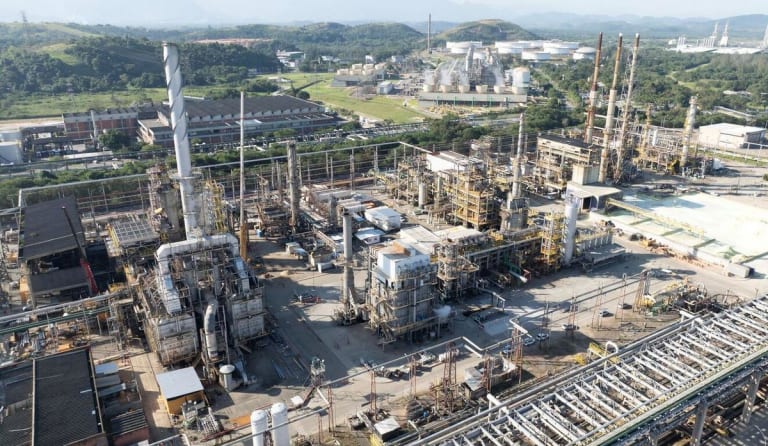
Petrobras has revised its strategic plan for 2027‑2031, forecasting a 28% rise in pollutant emissions by 2030 due to the resumption of refining, fertilizer production, and new investments in ethanol.
Petrobras has recalibrated its climate targets in the newly released Business Plan 2027‑2031.
The state‑owned company projects a 28% increase in its operational emissions by 2030, using 2025 levels as a baseline.
The adjustment raises the emissions ceiling to 64 million tonnes of CO2 equivalent.
This move reflects the company’s strategic shift under the leadership of President Magda Chambriard.
With the new direction, the oil major is altering the gradual pollutant‑reduction trajectory it had been following.
The strategy prioritizes productive growth in refining, petrochemicals, and biofuels.
Climate Target Revision and New Financial Commitment
The new target sets a reduction commitment of only 18% by 2030, based on 2015 levels.
Previously, the company had been working toward a 30% cut for the same period.
Despite the short‑term operational ceiling relaxation, the pledge to achieve carbon neutrality by 2050 remains unchanged.
The document notes, however, that this goal will depend on the use of carbon credits.
The rise in pollution indicators stems directly from the expansion of operational assets.
During the prior divestment period, the sale of refineries and oil fields had transferred the emissions of those units to third parties.
Bet on the Pre‑Sal and Adjustments in the Energy Transition
The five‑year plan projects a total budget of US$ 122 billion by 2031.
The largest share of the budget, amounting to US$ 87 billion, will continue to be allocated to oil exploration and production activities.
The pre‑sal polygon will absorb US$ 51.3 billion, reinforcing the importance of fossil fuels in the group’s cash flow.
Low‑carbon projects total US$ 13.5 billion, representing 11% of the overall budget.
Funding for the energy transition has decreased compared to last year’s plan.
Renewable sources such as wind and solar have had their resources cut to US$ 1.7 billion, prioritizing operational efficiency projects.
As justification for maintaining oil as the central focus of its investments, President Magda Chambriard highlighted the prudence in the company’s financial reallocation:
“We will remain strong in oil and gas. Most of our plan is dedicated to these projects. At the same time, we are building, with great discipline and caution, a diversified portfolio that currently includes ethanol.”
Return to the Biofuels Market
Alongside changes to environmental targets, Petrobras has officially returned to the sugar‑cane energy sector.
The state‑owned company acquired 42% of Neomille, a corn‑ethanol producer in the CerradinhoBio group, for R$ 2.8 billion.
The deal gives the oil giant direct involvement in processing the feedstock in the Central‑West region.
The goal is to expand the acquired company’s production capacity from the current 800 million to 1.5 billion liters per year by 2028.
The transaction complements the recent purchase of shares in Logum for R$ 620 million.
The acquired logistics network provides the necessary pipeline infrastructure for the biofuel’s distribution.
For the company’s leadership, the move supports a strategic goal of gradual diversification, as Magda Chambriard explained:
“Petrobras has been overdue for a return to ethanol for at least two years, and that is what we are realizing now—a very important step toward what we call a just energy transition.”
Future Energy Outlook
The relaxation of targets reflects Petrobras’s challenge of balancing industrial expansion with sustainability demands.
The company expects to reach its emissions peak around the turn of the 2030s.
Initiatives aimed at developing sustainable aviation fuel (SAF) and consolidating projects in states such as Rio de Janeiro, Pernambuco, and Mato Grosso do Sul form part of its long‑term vision.
The market will track the unfolding of these actions in the coming years.
The oil giant’s big test will be to demonstrate that expanding production capacity will not undermine the global environmental goals pledged through 2050.