

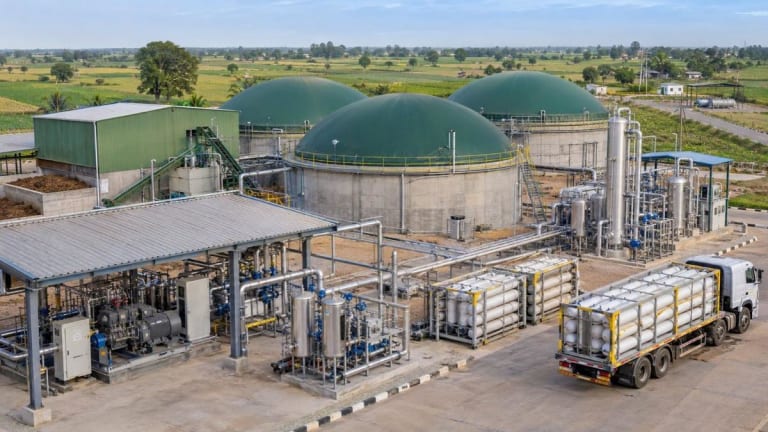
A study shows that India could save up to US$ 20.6 billion with compressed biogas, but logistical bottlenecks leave 75% of projects stalled.
India has significant potential to convert organic waste into renewable energy, reducing its heavy reliance on imported fossil fuels. However, the gap between theoretical production capacity and the sector’s operational reality remains a substantial challenge.
According to the report India’s Compressed Biogas Opportunity, prepared by the Confederation of Indian Industry (CII) in partnership with EY-Parthenon, the country could save up to US$ 20.6 billion annually by replacing imported liquefied natural gas (LNG) with compressed biogas (CBG).
Despite the optimistic projections presented in New Delhi, structural bottlenecks are hindering sector progress. By November 2026, only 210 of the 838 plants listed in the national program had entered full operation.
Challenge between theory and installed infrastructure
The data from the survey released by CII and EY-Parthenon indicate that about three out of every four registered projects remained outside the commissioning phase. Of the 838 projects recorded, 255 were under construction and 373 had not yet begun building.
The 210 operational units had a daily production capacity of 1,946 tonnes of CBG. Even operating at full capacity for all 365 days of the year, this volume would reach roughly 710,000 tonnes annually—far below the country’s theoretical potential.
In a report on the survey, the portal ETEnergyWorld highlighted interviews with 60 industry developers, who identified the main obstacles to expanding renewable fuel:
“Among the main obstacles reported by developers are ensuring a regular supply of raw material throughout the year, accessing financing, and the difficulty of securing buyers for the production.”
Grid isolation and limited distribution
One of the most critical issues identified in the study concerns the flow infrastructure. Of the 210 operational plants in the country, only 24 had direct connection to the existing pipeline network.
Without access to the distribution grid, producers must rely on road transport via cylinders or local supply contracts. This logistics chain adds costs that can make projects located far from major consumption centers commercially unviable.
The production of CBG occurs through anaerobic digestion of organic matter, such as agricultural waste and animal manure. After purification steps to raise methane levels, the product can perfectly replace conventional natural gas.
To boost infrastructure, the Indian government supports the sector through the GOBARdhan program, which focuses on incentives for biogas production and distribution. According to a Business Standard publication, the study acknowledges regulatory progress but emphasizes that results depend on the practical execution of projects.
Government targets and financial impact of the SATAT program
The study estimates that India generates 472 million tons of recoverable organic waste annually. This volume would allow the production of up to 62 million tons of CBG per year, enough to cover 80% of the national natural gas demand projected for 2030.
However, the maximum estimate of $20.6 billion in savings reflects a theoretical scenario of full import substitution, based on a projected price of $9.80 per MMBtu for the fiscal year 2025–2026.
In a scenario focused on government targets, the report analyzes the impact of the SATAT (Sustainable Alternative Towards Affordable Transportation) program, which sets a goal of producing 15 million tons of CBG annually by 2030.
If this goal is achieved, the volume would replace 37% of the LNG imported that year, generating an annual savings of $7.7 billion for the Indian economy.
Additionally, the country’s regulation requires a 5% blend of CBG with conventional gas starting in the fiscal year 2028–2029. This requirement will create an estimated demand of 620,000 tons in 2030, yielding an annual savings of $320 million.
Global Parallel and the Next Steps for the Sector
The gap between theoretical potential and commercial production is not unique to India. In Brazil, data released by Abiogás in September 2026 indicated a biogas potential of 120 million cubic meters per day, compared to an actual production of only 1.36 million cubic meters per day.
Presented at the 14th CII Bio‑Energy Summit, the report underscores the urgency of completing the registered plants, integrating them into pipelines, and developing commercial channels for the organic fertilizers produced as a by‑product of the process.
The future of India’s renewable mix will depend on how quickly the sector can structure supply chains and connect its producers to the consumer market. The progress of the 373 projects that have not yet begun will be the definitive indicator of whether India will meet its energy goals for the next decade.