

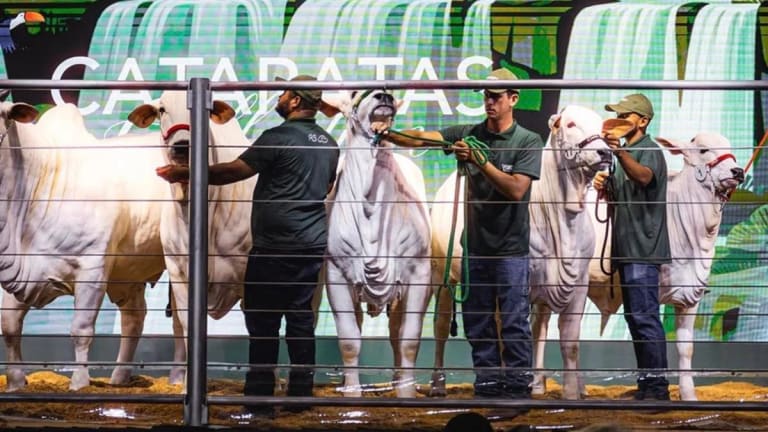
The Cataratas Collection 2026 auction marked a historic milestone for the national cattle industry, generating R$151.34 million in sales and valuing a Nelore matriarch at over R$22 million.
The elite bovine genetics market has just reached a new level of valuation. During the Cataratas Collection 2026 auction, held in Foz do Iguaçu, Paraná, the Nelore breed reaffirmed its economic power by moving R$151.34 million.
The amount represents a significant 10.68% increase compared to the previous edition, highlighting investors’ appetite for animals with superior lineages and high productive potential.
The event, promoted by Casa Branca Agropastoril and RS Agropecuária, stood out for its rigorously selected offering of 60 females. In a context where Brazilian livestock constantly seeks greater efficiency, the auction’s success underscores the strategic importance of genetic selection for herd development across the country.
The shine of Viatina V19 FIV Napemo
The highlight of the business round was the sale of one‑third of the Viatina V19 FIV Napemo matriarch to Agroparanã. The transaction value projected the animal’s total valuation at R$22.77 million.
The appreciation reflects the prestige of the lineage, as it is a direct descendant of the legendary Viatina‑19 FIV Mara Móveis, which holds the title of the world’s most expensive cow in the Guinness Book.
In addition to the matriarch’s share, the animal’s performance at the auction was complemented by substantial values in other genetic assets: an aspiration was bid for R$6.09 million, while a pregnancy was negotiated for R$1.965 million.
The Viatina V19 FIV Napemo, which recently earned the title of Grand Champion at Expoinel 2026, has become a central pillar for breeders seeking excellence in phenotype and productivity.
Paulo de Castro Marques, owner of Casa Branca Agropastoril, stated:
Its exceptional quality is being passed on to daughters and sons in various breeding farms across Brazil. It is our contribution to the ongoing strengthening of Nelore and, consequently, Brazilian livestock.
The Science Behind the Multi-Million Dollar Figures
The astronomical appreciation of these animals is not a matter of chance, but the result of advances in reproductive biotechnologies such as In‑Vitro Fertilization (IVF). Unlike commercial cattle, these breeding stock operate as true genetic powerhouses.
The technology allows a single elite cow to produce dozens of embryos each year, multiplying cutting‑edge genetics across multiple partner herds simultaneously.
Director of Casa Branca, Fabiana Marques Borrelli, emphasized that the outcome is the result of meticulous technical work:
Our commitment is to provide animals that truly make a difference on our partners’ farms. We are talking about better animals, multiplying and contributing to the development of the livestock industry.
Projections and Market
The business model based on “condominiums” — where investors acquire shares or quotas of the animals — has allowed financial risk to be spread among different groups.
This partnership strategy drives the circulation of elite genetics, enabling buyers to actively participate in future appreciation and the prizes won at prestigious shows such as ExpoZebu and Expoinel.
With the success of Cataratas Collection 2026, the expectation is that the auction market will remain hot for the rest of the year. The search for animals that carry the weight of consolidated genetic selection points to an increasing trend toward professionalization in the field, where the value of a bovine asset is measured by its potential to transform the national roster.