

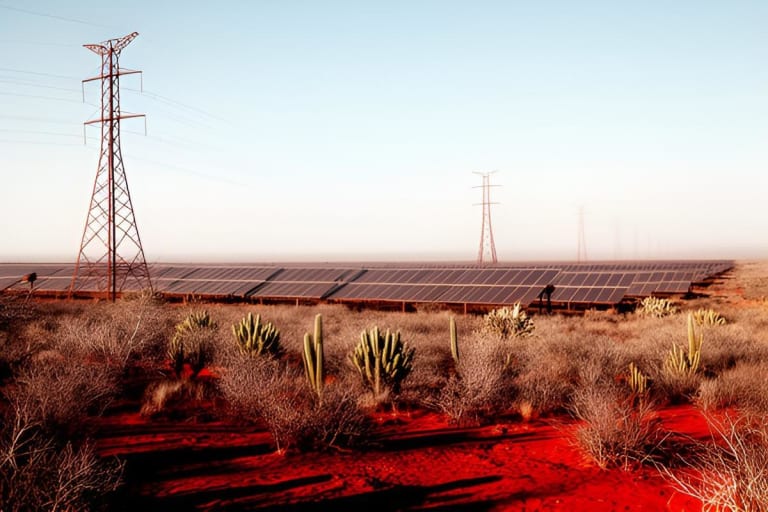
The lack of capacity to transmit power on Neoenergia Pernambuco’s grid forced the cancellation of an 80 MW photovoltaic project in the Pernambuco hinterland.
The Brazilian energy transition faces a new logistical setback, highlighting critical bottlenecks in transmission and distribution infrastructure.
The Barrinhas Photovoltaic Power Plant SPE officially submitted a request to revoke the concession for an 80 MW solar plant to be installed in Ouricuri, in the state of Pernambuco, to the National Electricity Agency (Aneel).
The main reason for the withdrawal is the lack of transmission margin identified at the Ouricuri substation, operated by Neoenergia Pernambuco.
According to the developer, the technical scenario has changed drastically from the initial studies, preventing a safe and viable connection of the photovoltaic complex to the regional grid.
The bottleneck in the distribution network
The technical feasibility of large renewable projects depends entirely on the transmission system’s capacity to accommodate the generated load.
In the case of the Ouricuri project, the most recent information provided by the distributor indicated operational restrictions that made maintaining the investment unsustainable.
The company highlighted in its statement to the regulator:
“The information currently available from Neoenergia Pernambuco indicates that the connection point planned for the project has begun to show restrictions regarding transmission availability, compromising the technical feasibility of connecting the plant under the conditions considered when the concession was granted.”
Because the project had not yet secured contracts in the Regulated Contracting Environment (ACR) or transmission and distribution commitments tied to operation, Aneel accepted the request to terminate the concession.
The formal decision was published in the Official Gazette of the Union (DOU) last Thursday, November 19, ending expectations for the 80 MW plant.
Overview of small authorizations and the electric sector
Despite the significant withdrawal in Pernambuco, the renewable energy sector continues to progress on other smaller fronts.
In the same act that formalized the withdrawal of UFV Solar Barrinhas, Aneel authorized the start of commercial operations and testing of new assets totaling 7.3 MW of installed capacity across different regions of the country.
Highlights include the solar plant SE Distribuidora de Alimentos in Cuiabá (MT), which received approval for commercial operation of 0.5 MW.
At the same time, the state of Mato Grosso sees the PCH Mutum I hydroelectric plant in Santo Antônio do Leverger begin its 4 MW testing phase.
Other projects, such as the solar plant MG080 in Espírito Santo (1.9 MW) and the Frisia solar plant in Paraná (260 kW), also had their test operations approved by the regulator.
The episode serves as a warning to investors and developers about the importance of continuously updating feasibility studies with local concessionaires.
As Brazil accelerates its solar mix, saturation of connection points at certain substations may become a recurring bottleneck, requiring companies to conduct increasingly rigorous risk analyses before consolidating new solar parks.
In the near future, the market’s focus should shift to modernizing existing grids and strategic planning so that renewable expansion is not hindered by physical transmission constraints.