

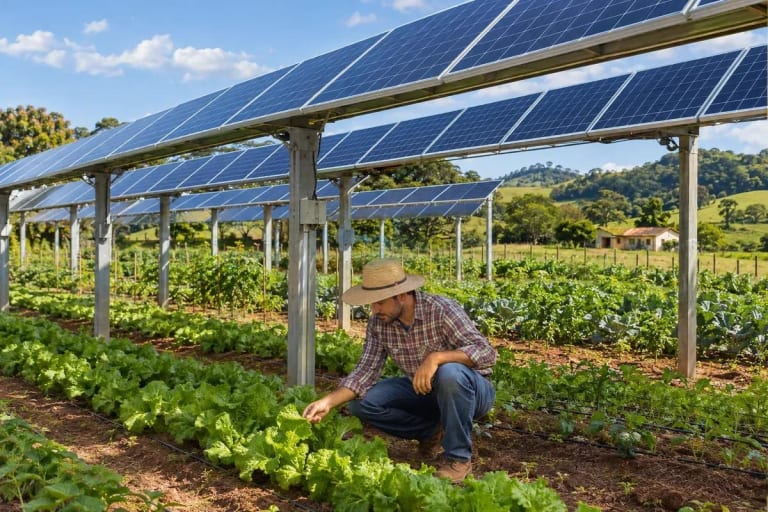
The integration of agriculture and solar energy, known as agrivoltaics, promises efficiency, but experts warn that financial success depends on rigorous planning and local testing.
The pursuit of higher profitability in farming has put the agrivoltaic model under the spotlight. Recently, the Ministry of Mines and Energy (MME) resumed strategic discussions with representatives from Chile and Germany to assess how this synergy between crops and solar panels can be adapted to the Brazilian reality.
The idea of producing electricity while cultivating food on the same land seems, at first glance, the ideal scenario. However, turning this idea into a reliable revenue source requires caution, as the Brazilian rural environment has climatic and operational peculiarities that make generic engineering solutions unfeasible.
The complexity behind the structure
The concept of agrivoltaics goes far beyond simply installing photovoltaic panels in the field. Unlike a conventional solar plant, where the ground is entirely occupied by panels, the agricultural project requires a planned architecture: elevated or spaced modules that allow the passage of heavy machinery, airflow, and proper crop management.
The placement of panels changes shade, airflow, and water use. Some crops may benefit from partial shade at certain times, while others need plenty of light; no result automatically transfers from a study to an entire farm.
Managing sunlight becomes an agronomic challenge. While shade can be beneficial for certain vegetables in hot regions, it can be fatal for the yield of crops that depend on high light incidence. Additionally, the installation must consider irrigation and harvest access, risking the technology—designed to add value—becoming an operational bottleneck.
The Myth of Double Revenue and Financial Challenges
One of the biggest misconceptions among producers is the belief that the energy generated will automatically translate into additional net profit. In practice, the gross revenue from electricity must cover complex operating costs, including maintenance of elevated structures, insurance, taxes, and the potential servicing of financing debt.
The MME noted that, at present, there are no universal credit programs exclusively for this model. Financial viability must be calculated based on the total productivity of the land. If installing panels results in a drop in crop yield—whether due to excessive shading or handling difficulties—the produced energy may serve only as compensation for what was lost in the harvest.
Strategy for the Rural Producer
Before investing, the technical recommendation is to avoid promises of magical returns. The producer should conduct a scenario analysis that includes periods of low agricultural productivity and climatic variations. It is essential to verify the technical feasibility of connecting to the local distributor’s grid and obtain detailed engineering estimates, as the cost of an elevated structure far exceeds that of a standard ground-mounted plant.
Start with a pilot area and define what will be measured: productivity per hectare, product quality, water consumption, electrical generation, maintenance, and labor hours. Compare the results with a similar cultivation area without panels.
The future of technology in the country depends on the consolidation of pilot projects that provide evidence across different biomes. While technical standards and public policies are still under debate, caution is the farmer’s best ally. The potential for income diversification exists, but it must be built on real data from the property, not on optimistic estimates from suppliers. Success depends on the harmony between energy efficiency and crop health.