

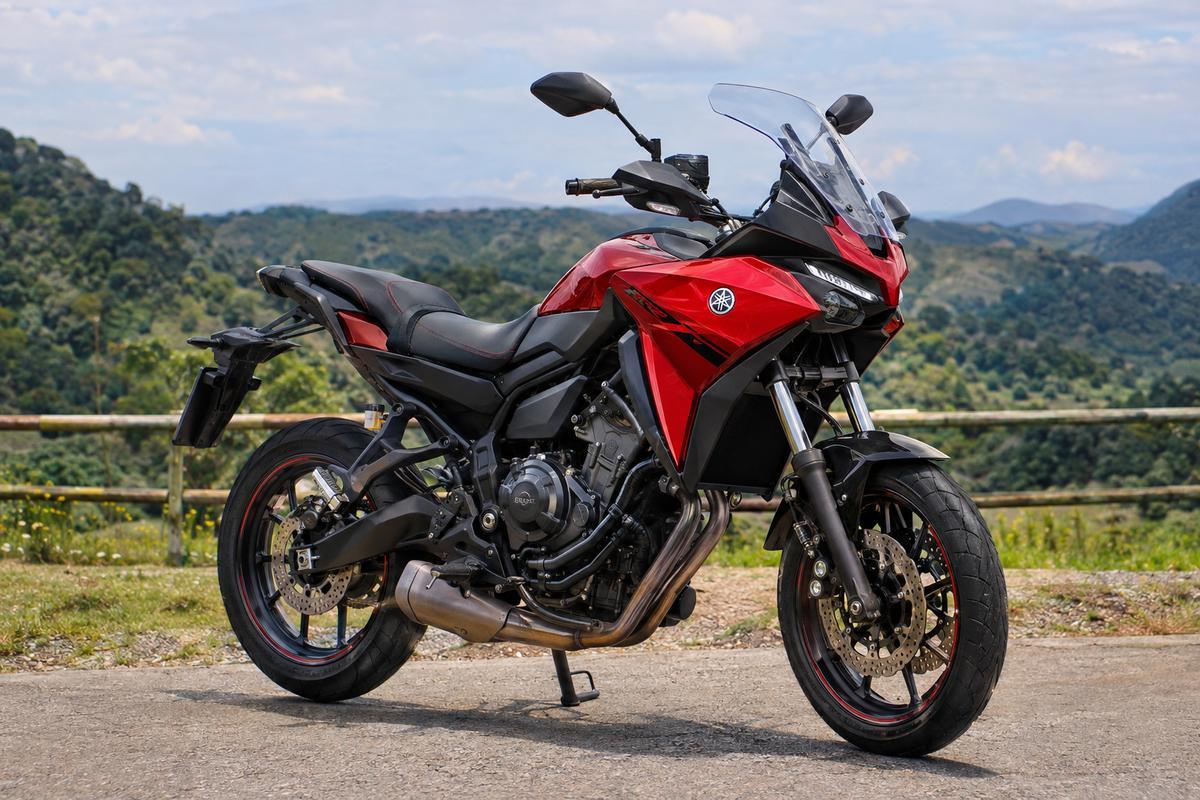
The Yamaha Tracer 7 2027 arrives in Brazil focused on comfort and technology, but details split opinions among enthusiasts and critics.
The new generation of the Yamaha Tracer 7 hits the Brazilian market with the promise of combining versatility, built‑in technology, and the well‑known performance of the Japanese manufacturer’s CP2 family. With a suggested retail price of R$ 59,990, the motorcycle produced in Manaus (AM) targets riders who want a bike suitable for both urban use and long‑distance trips. Yamaha’s bet centers on a package that includes cruise control, traction control, a modern connected TFT display, and a four‑year extended warranty, positioning it as a strong competitor to models such as the Honda NC750X, the Triumph Tiger Sport 660, and the Kawasaki Versys 650.
Performance and the Nuance of the CP2 Engine
At the heart of the Tracer 7 2027 pulses the renowned CP2 twin engine, with 689 cc of displacement, liquid cooling, and a 270‑degree crankshaft. This powerplant can deliver 73.4 hp at 8,750 rpm and 6.9 kgf·m of torque at 6,500 rpm, managed by a six‑speed transmission complemented by a slipper and assisted clutch, as well as Yamaha’s electronic throttle YCC‑T. The goal is to provide a progressive power delivery, ideal for daily traffic, without sacrificing agility on the road.
However, tests conducted and reported by Motociclismo magazine highlighted a particular characteristic of the Brazilian version. Journalist Ismael Baubeta noted a dip in engine excitement between 4,000 and 6,000 rpm, followed by a return of vigor at higher revs. This recalibration was linked to necessary adaptations to meet Brazil’s stringent emission and noise regulations, an interpretation of dynamic behavior rather than a sign of mechanical failure.
Technology and Connectivity in the Spotlight
One of the pillars of the Yamaha Tracer 7 is its rich electronic package. Cruise control, operating between 40 and 180 km/h from third to sixth gear, enhances comfort on long rides. Added to this are adjustable traction control, an electronic speed limiter, and two riding modes configured for the national market.
The five‑inch TFT color display serves as a command center, enabling smartphone integration via the Y-Connect app. This connectivity opens the door to map display and arrow navigation using the Garmin StreetCross service. Convenience extends to a USB‑C port, full LED lighting, and an automatic braking alert system.
Despite the technological leap, points such as the lack of a factory quickshifter and the fact that the ABS system is not advertised as corner‑slope sensitive spark debate among the most demanding riders.
Comfort and Road Adjustments
The Tracer 7‘s riding dynamics are anchored in a diamond‑style steel chassis, with a 41 mm inverted KYB front suspension and a Monocross rear unit. Braking is handled by 298 mm front double discs with four‑piston radial calipers, and a 245 mm rear disc, both assisted by ABS.
Rider comfort is a standout feature, with a seat adjustable in height (between 830 and 850 mm) and a manually adjustable windscreen. The 18‑liter tank and a curb weight of 203 kg complete the specifications. In tests, the suspension set was praised for its balance between absorbing road imperfections, corner stability, and overall ergonomics—critical factors for those planning long rides.
Fuel Economy, Maintenance, and Market Position
Yamaha does not publish an official fuel consumption figure for the model in Brazil. International data point to an average of 20 to 22 km/l under ideal conditions. Assuming 20 km/l with an 18‑liter tank, the theoretical range can reach about 360 km, though real‑world usage varies significantly.
Ownership costs include not only the suggested price of R$ 59,990 but also expenses such as shipping, registration, fuel, insurance, IPVA, and maintenance. Yamaha’s Fixed‑Price Service Program and a four‑year warranty add further appeal.
Compared directly with its rivals, the Tracer 7 delivers more power than the Honda NC750X, while the Triumph Tiger Sport 660 stands out with a more powerful inline‑three engine. The Kawasaki Versys 650 comes with a lower suggested price. The final choice will depend on each rider’s individual priorities, but Yamaha strongly bets on the synergy between its CP2 engine, ergonomics, and extended warranty.
Conclusion: A Balanced Option with Caveats
The Yamaha Tracer 7 2027 establishes itself as a solid alternative in the mid‑displacement motorcycle segment for the road. Its blend of adequate power, touring comfort, and technological features puts it in the spotlight. However, the lack of a factory quickshifter and some quirks in the engine’s power delivery may be points of consideration for riders seeking a more sporty character. The November 2026 Fipe table, listing a reference value of R$ 62,000, indicates that the manufacturer’s suggested price could offer an initial advantage. The purchase decision, especially for those prioritizing long‑distance travel, should culminate in a thorough test ride, evaluating the bike’s ergonomics and response in various situations.