

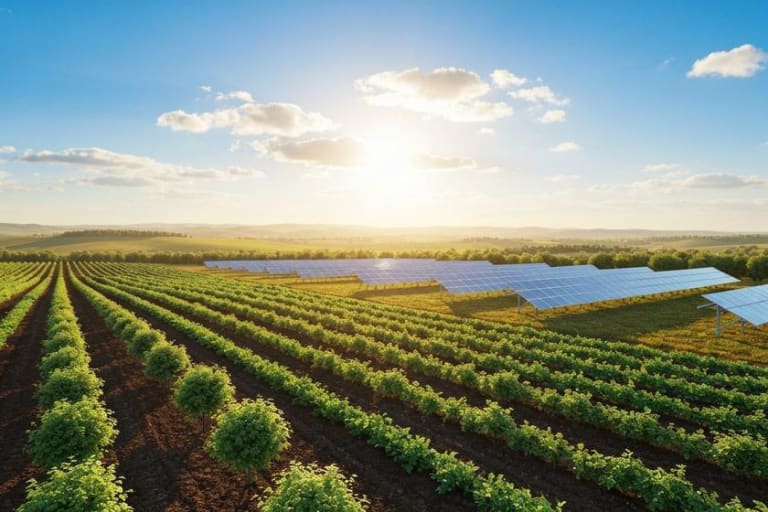
Paraná expands the RenovaPR program with a 3‑percentage‑point interest subsidy to finance hybrid batteries and inverters, ensuring energy storage and continuity of farm operations during power outages.
The state of Paraná takes a decisive step toward farm resilience by deciding to subsidize 3 percentage points of interest for farm producers who already generate clean energy and wish to install energy storage systems. The initiative expands the renowned RenovaPR program, established by State Law No. 20.435/2020, to address a long‑standing technical hurdle: the automatic shutdown of solar systems during grid failures.
Since August 2021, the state has achieved impressive progress with the installation of 45,274 rural distributed generation units, totaling 1.11 GW of capacity and roughly R$ 6.4 billion in investments. This strong expansion was driven by the gradual elimination of rural tariff discounts, mandated by Federal Decree No. 9.642/2018, making the pursuit of efficiency and energy autonomy even more urgent for Paraná’s agribusiness.
Expanding the program to include batteries does not require new legislation, as it builds on the solid existing legal framework and the Banco do Agricultor Paranaense. Coordinated by the Secretariat of Agriculture and Supply (Seab) and technically executed by IDR-Paraná, the program uses funds from the Economic Development Fund managed by Fomento Paraná, creating a robust ecosystem for sustainable energy transition.
The Technical Challenge of Farm Outages
A grid‑connected photovoltaic system automatically shuts down when power is lost, even under full sun. This is the anti‑swing protection requirement designed to prevent inverters from energizing lines under maintenance and endangering utility workers.
In practice, even with its own solar power, a rural producer remains vulnerable. Sudden interruptions halt ventilation, milking, milk cooling, and aeration, causing significant losses. The technical solution to this bottleneck is a hybrid inverter paired with a battery bank, creating a local microgrid that can isolate critical loads and keep operations running.
Financing Conditions and Costs
The state government incentive consists of a direct interest rate subsidy, administered by the Banco do Agricultor Paranaense. With resources of about R$ 320 million spread across 398 municipalities, the line covers properties that already have self‑generation via solar power or biogas, financing the purchase of storage batteries and modern inverters.
The producer who invested in self‑generation remains exposed to interruptions. Ventilation, milking, cooling, and aeration are affected.
Battery system costs range from R$ 35,000 to R$ 800,000, with an average estimated by IDR-Paraná at R$ 78,000, yielding a financial return calculated between 4.5 and 7 years. Additionally, the international market shows historic price declines for components, further boosting the economic viability of these projects in Brazil.
Essential Precautions Before Investing
The greatest beneficiaries of this technology are sectors that cannot tolerate interruptions, such as poultry, aquaculture, and the production of animal protein and tobacco. However, before finalizing any contract, the producer must carefully analyze several fundamental factors:
- Critical loads: Identify which equipment must operate during a blackout and for how long, sizing the capacity in kWh appropriately.
- Property network: Note that the vast majority of properties run on single-phase or two-phase systems.
- Technical safety: Require designs by qualified professionals, with fire protection systems and adequate ventilation.
- Appropriate technology: Choose safe, long-cycle-life chemistries such as Lithium‑Iron‑Phosphate (LFP).
The RenovaPR program successfully moves from the generation phase to the continuous energy assurance phase. The interest subsidy dramatically reduces the financial burden of an investment that protects crops and livestock from severe losses caused by blackouts.
With the global decline in battery costs and easier credit, the shift to autonomous systems becomes a watershed moment for agriculture. Paraná’s pioneering model shows how well‑structured public policies can turn structural challenges into growth opportunities, serving as an inspiring reference for the entire country.