

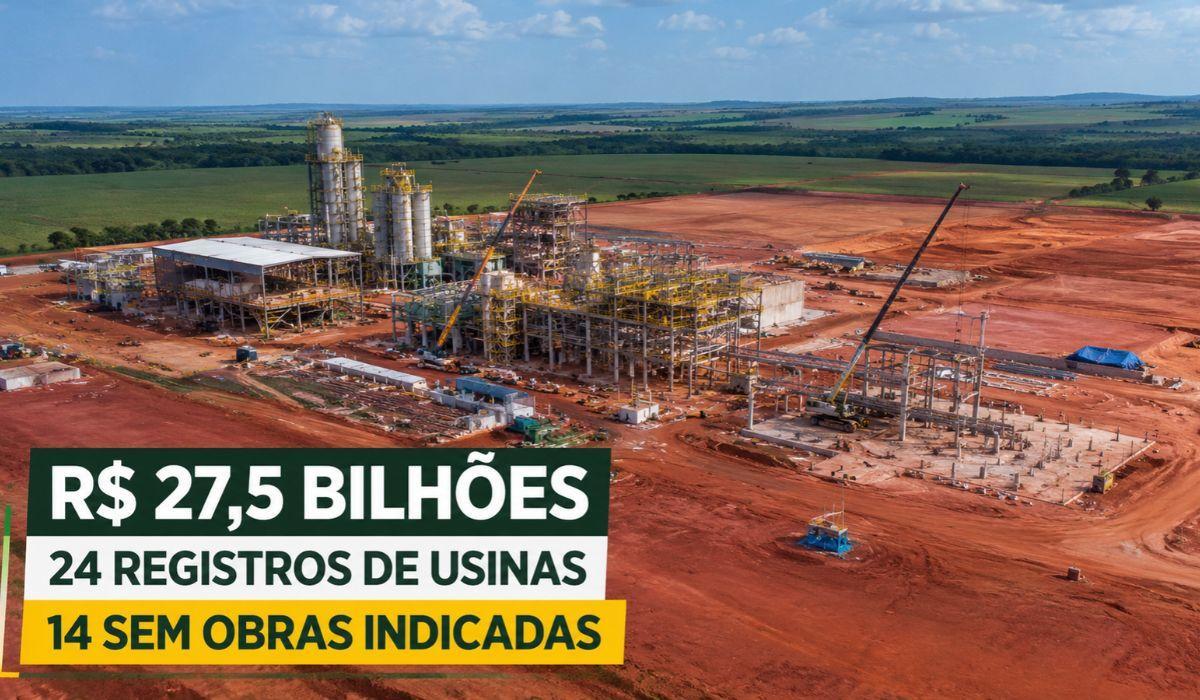
Mapping shows R$ 27.5 billion projected for Brazil’s corn‑ethanol sector, yet most mapped projects have not yet begun construction.
The Brazilian biofuel sector is experiencing a strong wave of financial projections focused on cereal processing. A recent mapping by Radar Capex points to a portfolio of R$ 27.5 billion earmarked for expanding corn‑ethanol production units in the country.
Distributed across seven states, the total investment includes 24 entries covering new plants and operational expansions. However, the execution pace reveals clear disparities between formal planning and concrete mobilization on construction sites.
Most of the monitored proposals remain in preliminary stages. Of the cataloged projects, 14 await phases such as environmental licensing or securing financial resources before their factory structures are erected.
Industrial concentration in the Central‑West and South
The state of Mato Grosso stands out as the main hub for this capital volume, hosting 10 entries totaling R$ 11.1 billion. Proximity to grain harvest areas attracts bioenergy giants.
Among the largest initiatives in Mato Grosso are the new Inpasa plant in Rondonópolis, budgeted at R$ 2.77 billion, and two FS projects in Campo Novo do Parecis and Querência. The region also hosts companies such as RRP Energia and ALD Bioenergia.
The state of Goiás ranks second with five projects valued at R$ 6.7 billion, with planned plants in Rio Verde, Cristalina, Formosa, and Chapadão do Céu. In Paraná, R$ 4.9 billion is spread across three strategic initiatives.
The investment list is completed by Mato Grosso do Sul, which has three entries led by Atvos in Nova Alvorada do Sul, plus occasional participation in states such as Bahia, Minas Gerais, and Piauí.
Construction pace and duplicate entries
Despite the large sums, only eight projects show physical progress on site, with heavy machinery and industrial structures being assembled. Two additional plants are already listed as operational in the report.
One of the most advanced examples belongs to the cooperative Coamo, located in Campo Mourão, Paraná. The factory installation has an estimated investment of R$ 1.7 billion and a daily capacity to process 1,700 tons of corn.
The cooperative reported:
“More than 60% of the work on our factory structure in Campo Mourão has already been completed,” the cooperative said, outlining a schedule with an expected start of operations in March 2027.
On the other hand, initiatives such as the one by Grupo Potencial in Lapa remain in the announcement phase. Experts warn that the transition from license requests to the start of foundations follows strict bureaucratic and financial procedures.
A detailed analysis of the survey requires caution regarding the total sum of R$ 27.5 billion. The report includes duplicate entries resulting from different funding phases for the same project.
A representative case occurs with RRP Energia in the municipality of Tapurah. The plant appears duplicated in the survey due to the approval process for a R$ 1 billion credit with the National Bank for Economic and Social Development, the BNDES.
A similar dynamic repeats in the expansion project of ALD Bioenergia in Nova Marilândia. The simultaneous inclusion of operations via the Climate Fund and lines for machine acquisition inflates the total value when summed separately.
Co-product generation and added value in the field
The expansion of the industrial network for corn ethanol increases the full utilization of the grain harvest. The technology allows the extraction of the biofuel without discarding the cereal’s protein and lipid fractions.
The plants produce valuable inputs for agribusiness, such as vegetable oil and DDG (or DDGS), a high-nutrient ingredient used in livestock feed formulation.
With the financial support approved by the BNDES, the ALD Bioenergia plant plans to raise its processing from 335,000 to 900,000 tons of grain per year, boosting biofuel production to up to 400 million liters annually.
The consolidation of these industries fuels demand for equipment, grain storage, and energy infrastructure in the producing regions. The market now tracks the actual conversion of these announcements into new operational smokestacks across inland Brazil.