

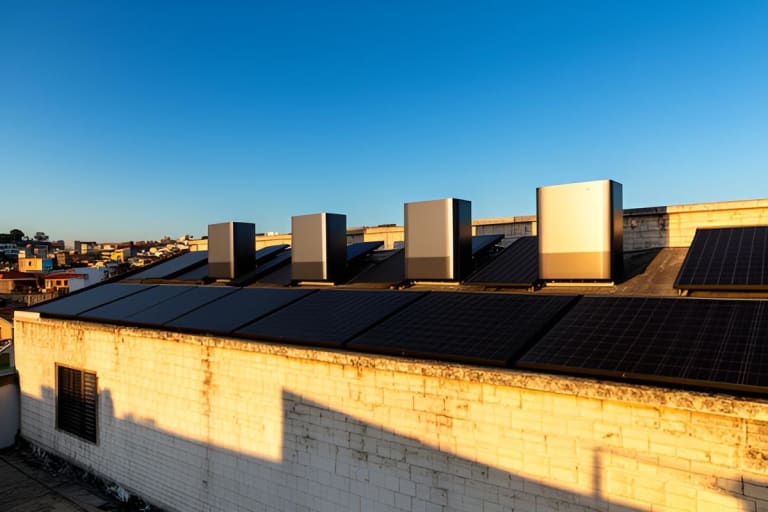
The solar energy market in Brazil is experiencing a slowdown in the first half of 2026, prompting integrators to diversify their portfolio with batteries and electric vehicle chargers to stay competitive.
The distributed solar energy sector in Brazil is going through a transition period. After years of rapid expansion, the market saw a contraction in the volume of new connections during the first half of 2026. According to a study by Greener, 3.97 GW was added to the national grid, representing a 23% decline compared to the same period in 2025.
Although the total installed capacity in the country already reaches the impressive figure of 53 GW, the pace of new additions has slowed significantly. The volume of imported modules, a key indicator of supply for the market, fell 48%, totaling 5.5 GWp. This scenario does not mean the sector has collapsed, but it presents a new challenge for integrators: how to maintain financial sustainability when the race for traditional photovoltaic panels loses momentum?
The shift to hybrid systems and mobility
In light of this scenario, the strategy of installation companies has been diversification. The Greener study shows that 86% of industry professionals already offer hybrid systems in their catalog, while 63% have begun to provide infrastructure for electric vehicle charging. The bet is to turn the existing customer base into a continuous revenue source, leveraging the trust built in previous projects.
However, experts warn that the transition from a panel installer to an energy storage solutions provider is not trivial. The technical complexity requires much greater rigor than simply selling conventional photovoltaic equipment.
“Batteries require design, safety, service, and capital that go beyond selling another box. Offering them is not about large-scale installation; the financial outcome depends on acquisition price, sizing, labor, warranty, and the ability to explain the return to the customer.”
What Consumers Should Consider
For the end customer, the promise of energy independence through batteries must be evaluated with caution. A hybrid system undoubtedly provides valuable backup against power outages—a decisive advantage for those who maintain home‑office setups or small businesses. However, the cost‑benefit ratio needs to be analyzed transparently.
The system’s autonomy depends directly on consumption patterns and equipment specifications. It is essential for consumers to understand that storage capacity in kWh alone does not guarantee that all household appliances will remain operational during a blackout. The output power (kW) and the choice of circuits to be preserved are variables that can dramatically alter the investment’s effectiveness.
Future Outlook for the Sector
The recommendation for solar companies is to exercise caution in inventory management and focus on technical training. Before expanding the portfolio to batteries and chargers, the integrator should test local demand and ensure that its team is capable of performing complex sizing, thereby avoiding later costs from technical corrections or ineffective warranty claims.
The Brazilian solar market has not disappeared; it has matured. The slowdown forces a natural selection where service quality and consultative capability will be valued as much as product price. In the near future, a company’s survival and profitability will depend less on the raw volume of panels sold and more on delivering customized solutions that truly address the specific pain points of the end consumer, whether in tariff savings or in protection against grid failures.