

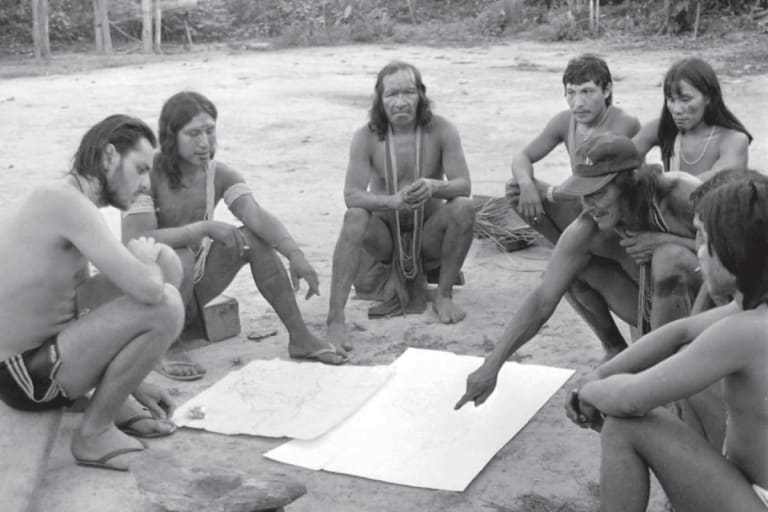
The Wajãpi people celebrate 30 years of the demarcation of their Indigenous Land in Amapá. The milestone cemented a pioneering model of participatory management, ensuring the preservation of the forest and the autonomy of Brazil’s indigenous peoples.
The Wajãpi people marked, on November 13 and 14, 2026, three decades of a historic milestone for the indigenous movement in Brazil: the ratification of the demarcation of their territory in the state of Amapá. The celebration, held in the village of Kwapo’ywyry, not only celebrated the achievement of territorial rights but also reinforced the importance of collective organization in protecting the Amazon and resisting external threats.
The process, completed in 1996 after a long identification period that began in 1980, became a national reference. By actively leading the physical demarcation of their lands with technical support from partners, the Wajãpi people inaugurated a model of participatory territorial management. This approach transformed the relationship between the communities and the State, placing indigenous leadership at the center of environmental defense and the maintenance of their traditional ways of life.
Environmental preservation and autonomy
Three decades after the land was formalized, the more than 607,000 hectares protected by the Wajãpi people remain a conservation example. The area is a sanctuary of standing forest, with no significant records of deforestation, housing clear waters and rich biodiversity essential to the country’s climate balance.
Kumare Waiãpi, chief of the village of Pairakae, reports:
“That’s why we demarcated, because many want to take our land. There were mining operations on our land. There were hunters and fishermen who left the rivers polluted. They contaminated the rivers, the fish, the hunts, and the land. The demarcation was very good because it protects us from enemies.”
For supporters of the cause, such as Lucia Szmrecsányi, coordinator of the Wajãpi Program at the Instituto Iepé, the deep involvement of local groups in territorial management is what ensures the effectiveness of this protection to this day.
A Legacy of Culture and Resistance
The commemorative celebration, which included the traditional pakumeme (pacu fish festival), symbolizes the cultural resilience of this people. The event received support from several entities, such as the Wajãpi Villages Council – Apina and the Heinrich Böll Foundation, highlighting the union between ancestral knowledge and the strategic backing of partner organizations.
Regine Schönenberg, director of the Heinrich Böll Foundation in Brazil, emphasizes that the impact of the demarcation goes beyond geography:
“Thirty years later, the demarcation remains a milestone in guaranteeing the territorial rights and autonomy of indigenous peoples. Recognizing and protecting an Indigenous Land is far more than setting geographic boundaries; it means ensuring the conditions for the continuity of ways of life, cultures, knowledge, and the relationships of peoples with their territories.”
Impact on Conservation and the Future
The experience of the Wajãpi confirms that protecting indigenous lands is one of the most effective strategies for addressing the global climate crisis. By ensuring that forests are preserved, these territories act as vital barriers against illegal mining, predatory deforestation, and biodiversity loss.
Anthropologist Dominique Tilkin Gallois, who closely followed the process, notes that the Wajãpi not only learned to defend their boundaries but also to manage, in a harmonious way, coexistence with neighboring populations. The success of this journey, guaranteed by Article 231 of the 1988 Federal Constitution, serves as an indispensable guide for maintaining territorial rights and the future of sustainability in Brazil. The 30‑year celebration, therefore, is an invitation for the country to renew its commitment to protecting forests and respecting the sovereignty of peoples who have always been the guardians of life in the forest.