
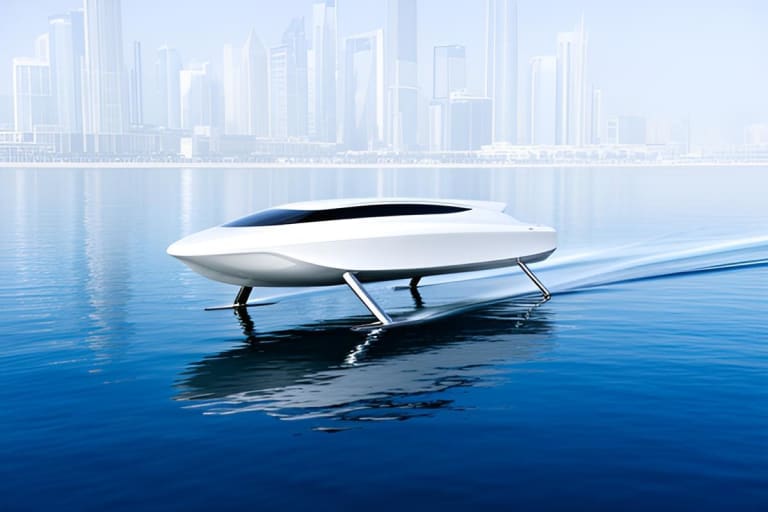
Urban navigation is undergoing a quiet revolution in the United States, where electric ferries equipped with hydrofoil technology promise to transform aquatic mobility with sustainability and high efficiency.
River and bay navigation in North America is experiencing a profound transformation driven by the need to decarbonize. Historically overlooked compared to land transport, water transport is beginning to adopt battery-powered vessels to modernize urban passenger movement.
The movement gains momentum with the advancement of technological solutions capable of overcoming the main bottleneck of river electrification: the strong resistance that water exerts on traditional hulls. In this context, the use of electric ferries emerges as a viable alternative to integrate mobility in major metropolises.
The innovation of hydrofoils in maritime transport
Unlike cars, moving a vessel requires a substantial amount of energy due to the density of the aquatic medium. To overcome this obstacle and avoid the excessive weight of batteries, engineers are betting on hydrofoil technology.
These structures act as submerged wings that lift the boat as speed increases. By lifting the hull out of the water, friction drops dramatically, enabling longer routes with lower energy consumption.
According to manufacturer Vessev, the system reduces water drag by about 66%. This efficiency allows the use of smaller batteries without compromising the necessary range for commercial transport.
Eric Laakmann, CEO and co‑founder of Vessev, said:
“We have substantially reduced the drag you feel, and that’s what really makes electrification viable.”
Practical tests and international projection
During recent demonstrations at the New York port, the company’s model showcased its capability by gliding smoothly half a meter above the surface. The quiet and stable navigation captured the attention of passengers in the area.
The technology is already operating commercially in New Zealand and is slated for expansion to Australia, with an initial route planned in the United States, located on Lake Tahoe.
The developers aim to turn these boats into everyday modes of transport as common as buses or subways in coastal cities.
In Europe, the concept is advancing rapidly. In Stockholm, vessels from Candela consume up to 80% less energy than diesel models, while Norway has ordered 20 units for its maritime routes.
The modernization plan in San Francisco
In the United States, major urban centers are already structuring the transition of their fleets. In San Francisco, a half‑billion‑dollar program envisions electrifying the system that serves millions of passengers each year.
Although the four new vessels acquired for the bay do not use hydrofoils, the project will give the city the first all‑battery high‑speed water service in the country.
Implementation requires complex adaptations to terminal infrastructure to allow rapid charging between operational trips.
Seamus Murphy, director of the agency responsible for the region’s ferry system, emphasized:
“We have an extensive coastal area.”
Economic viability and sustainability
Despite the high upfront cost, electric motors are more efficient and require less maintenance than diesel propulsion. Fluctuations in fossil fuel prices reinforce the competitiveness of this transition.
Beyond the long‑term financial advantage, the shift directly reduces greenhouse gas emissions and improves air quality in port zones and waterfront neighborhoods.
Seamus Murphy added:
“You make the initial investment and then save over time, and in the end you’ll have lower long‑term costs.”
Outlook for the future of river mobility
The focus on domestic production of these vessels in the U.S. also aims to strengthen the local industry and create green‑economy jobs.
The gradual replacement of diesel engines with electric models signals a new ecosystem for global inland water transport, combining technological innovation and environmental stewardship.