
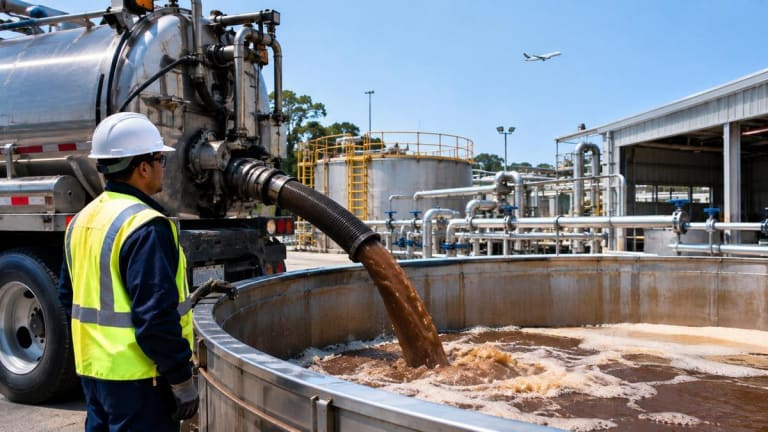
A new initiative in Newark, United States, promises to turn up to 56.8 million liters of discarded grease into raw material for sustainable aviation fuel production.
Waste management in large urban centers has just gained a new ally with the potential to impact commercial aviation. In a strategic move to mitigate chronic sanitation problems, the Passaic Valley Sewerage Commission (PVSC), which treats sewage for 1.6 million people in New Jersey, announced the implementation of an advanced industrial system to process grease removed from commercial kitchens and restaurants.
The project, made possible through a partnership with Greasezilla, can process up to 15 million gallons—about 56.8 million liters—of waste per year. By separating the oily fraction from the discarded material, the utility not only protects the network infrastructure from blockages but also generates valuable raw material for the renewable fuels market, such as SAF (Sustainable Aviation Fuel) and renewable diesel.
The technical challenge: turning a problem into a solution
In kitchens, improper disposal of oils and fats, known by the acronym FOG (fats, oils and grease), is one of the biggest villains of the sanitation network. When this material cools in the pipes, it solidifies, reducing flow capacity and causing leaks that require costly interventions. The technology selected by PVSC proposes a circular economy solution to this challenge.
The process uses thermal separation tanks to break down the mixture into three distinct components: residual water, pasteurized solids—which can be directed to composting—and the so‑called “brown grease.” Unlike traditional methods that require chemical inputs, the system in Newark will use the steam already present in the treatment plant’s boilers, increasing the operation’s energy efficiency.
Tom Laustsen, operations director of PVSC, highlighted:
“The installation was chosen after a rigorous sector assessment, aiming to improve the management of concentrated greasy waste, protect our regional collection network, and reduce the operational difficulties caused by these loads.”
Connecting to the Global Biofuels Market
It is important to note that the Newark facility will not produce aviation fuel itself, but rather the basic feedstock that will feed refineries. The recovered brown grease meets the technical specifications required for the HEFA hydroprocessing route, the most common method for producing SAF. Demand for this type of raw material is growing, driven by energy giants such as bp, which recently signed strategic agreements to expand the scale of waste recovery in the United States.
The Newark initiative reflects a broader movement that also reverberates in Brazil. With the implementation of the ProBioQAV program under the Future Fuel Law, the Brazilian government set ambitious targets for decarbonizing the aviation sector. Starting in 2027, airlines will be required to progressively reduce emissions, making used cooking oil and other residual fats key pieces on the energy transition board.
The success of the unit in New Jersey will serve as a barometer for other global metropolises. By integrating basic sanitation into the biofuels value chain, the project demonstrates that waste previously seen only as an environmental liability can, with the right technology, sustain the wings of future aviation.