
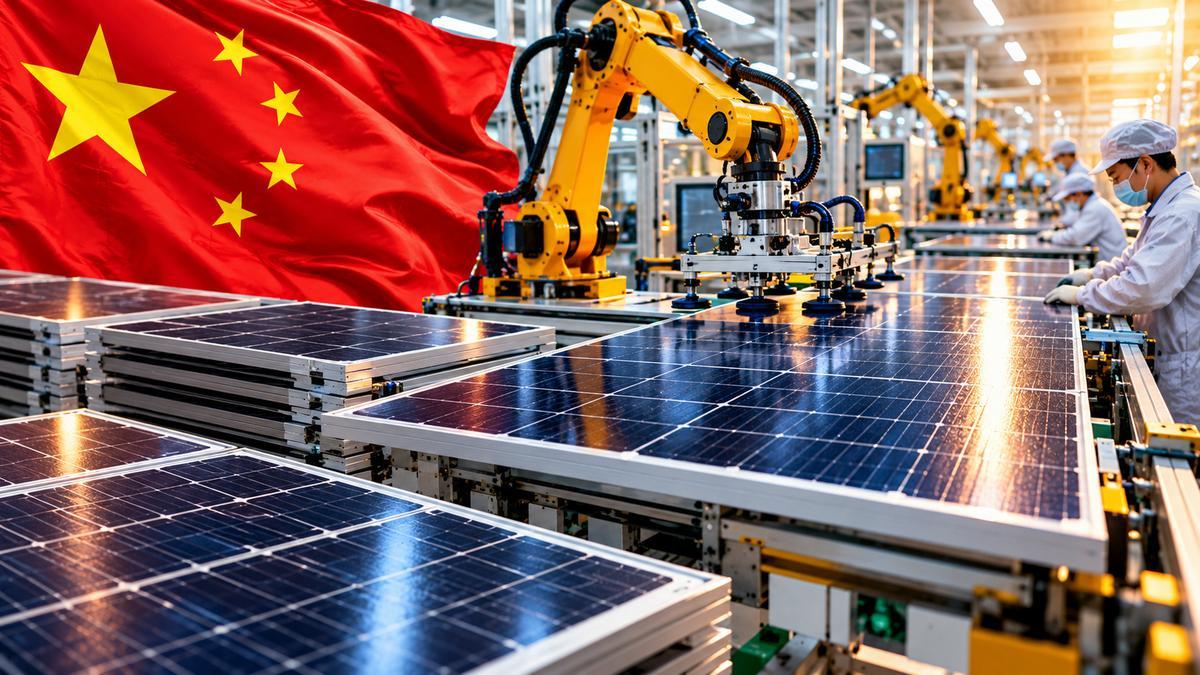
China hints at restrictions on cutting-edge solar technologies, creating uncertainty for the global industry.
The clean solar energy landscape may be on the verge of a significant shift, as the Chinese government proposes barriers to the transfer of 12 crucial technologies used in the manufacturing of photovoltaic panels. The measure, introduced on October 16, 2026, aims to safeguard what Beijing considers sensitive technologies critical to its national security, directly impacting foreign companies seeking access to state-of-the-art processes.
The proposal, which will still undergo public consultation, scrutinizes production methods for solar cells with efficiency rates exceeding 30%, as well as manufacturing processes for polysilicon and silicon wafers. The initiative does not ban the export of finished solar panels, but focuses on the technical know-how, equipment, and industrial methods that enable the production of more efficient components.
Technological Dominance in Solar Energy
China, the world leader in solar panel production, seeks with this measure to redefine the landscape of innovation and manufacturing in the sector. The proposal establishes stricter control over the transfer of technologies, including the installation and upgrading of industrial lines outside its territory.
The goal is clear: to protect expertise that, according to the Chinese Ministry of Commerce, transcends conventional power generation, finding applications in sectors such as aerospace and defense. This national security justification signals a new level of control over the solar energy supply chain.
High-Efficiency Cells in the Spotlight
Among the most targeted processes are tandem perovskite-silicon solar cells, which combine different materials to maximize light-to-electricity conversion. Technologies that use silicon wafers of at least 182 millimeters and achieve efficiencies of 30% or higher may be prohibited from international transfer.
The proposal also covers production methods for larger modules, such as the “slot-die coating” technique, and processes for perovskite modules with specific surface areas and defined minimum efficiencies. For an industry that is relentlessly striving to increase efficiency and reduce costs, these restrictions represent a significant challenge.
Raw Materials and Fine Components Under Control
Chinese influence extends to the initial stages of solar manufacturing. Advanced polysilicon production methods, such as fluidized bed reactor processes, and high-capacity cold hydrogenation technologies are also included in the list of potential restrictions.
Likewise, the manufacturing of extremely thin silicon wafers, with thicknesses of 70 micrometers or less, could have their transfer controlled. These thin wafers optimize silicon usage but require delicate manufacturing processes.
Global Impact and the Future of Production
Manufacturers in the United States and India have already expressed concerns about how this new policy will affect their expansion plans and the development of their own domestic solar industries. Uncertainty looms over future access to essential equipment and expertise.
In Brazil, companies planning to invest in local panel manufacturing will need to closely monitor the Chinese decision. The acquisition of advanced technologies and the formation of industrial partnerships could be directly influenced by these new control regulations.
The public consultation on the proposal ends on November 15, 2026. Beijing‘s final decision will shape the future of solar energy production, reconfiguring the map of innovation and investment in a sector that is increasingly strategic for the global energy transition.