
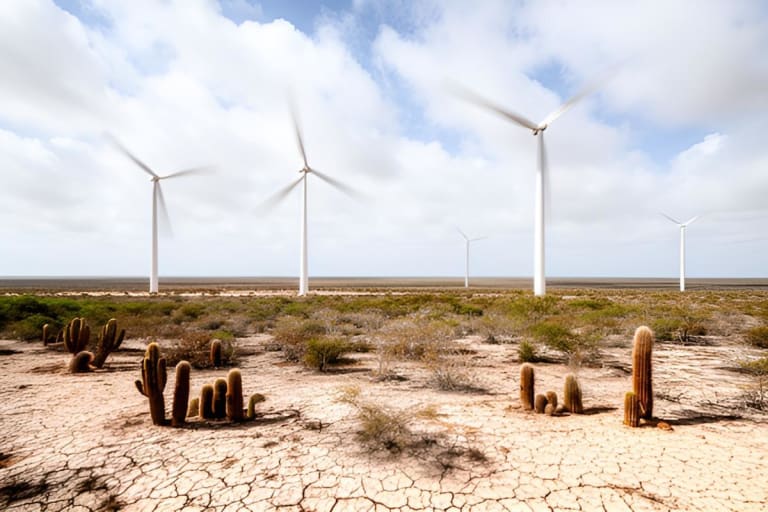
The advance of El Niño could cause significant shifts in the atmospheric circulation of Northeast Brazil, raising important alerts for the country’s wind energy generation throughout 2027.
The transition in global climate patterns is once again flashing a yellow light for the clean energy sector in Brazil. Experts point out that the activity of El Niño has the potential to alter wind patterns in the Northeast region, directly impacting the performance of production farms starting next year. The analysis, prepared by the specialized consultancy Tempo OK, comes after a cycle marked by instabilities and wind volumes below historical averages in several monitored areas.
Wind behavior over the past year had already created operational challenges for companies in the segment. Between June and September, cumulative volumes were 1% to 8% below expectations, reflecting prolonged sequences with speeds up to 25% lower than average. Although November and December present more encouraging prospects for energy capture, early 2027 could register a slowdown in air mass flow, requiring heightened attention from operators.
Direct Impact on Energy Production
The sector’s sensitivity to the whims of the climate becomes evident when observing the ratio between wind speed and the electricity injected into the grid. Small fluctuations in air current intensity cause disproportionate reductions in the final delivery of megawatts, compromising corporate planning and operating revenue stability.
Commenting on this dynamic of losses in energy conversion, expert Paulo Lombardi points out:
A 4% drop in wind can represent something close to 10% to 12% less energy. But regularity weighs just as much as intensity.
The sudden alternation between calm days and periods of strong breezes prevents assertive predictability, increasing financial risks in the short-term market.
Meteorologist Ana Penna reinforces that this scenario of climate volatility deeply impacts the commercial management of these ventures.
This oscillation reduces the capacity factor, hinders short-term forecasting, and increases generators’ exposure to contractual deviations.
Regional Variations and the Weight of El Niño
The climatic phenomenon does not act uniformly across the Northeast territory, requiring detailed analyses by microregion. Data compiled by Aneel show that the region is home to about a thousand renewable energy complexes, serving as the country’s main generation hub. However, the interior—particularly south-central Bahia and the state of Piauí—demonstrates greater vulnerability to the interference of cold fronts, while the northern coast tends to maintain greater stability.
Given this challenging landscape, advanced meteorological monitoring becomes essential to anticipate bottlenecks in electricity production. The debate over these projections and the future of the renewable matrix is gaining traction in the sector, with strategic discussions scheduled for major market gatherings such as Brazil Windpower. Technological and predictive adaptability will be the key differentiator for wind farms to avoid losses amid atmospheric surprises.