
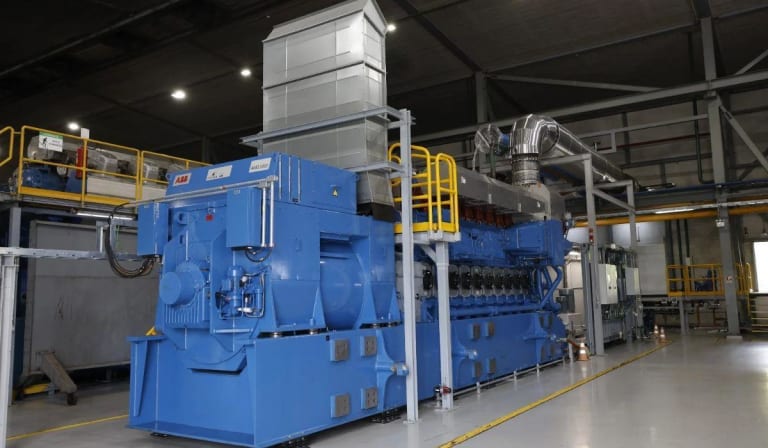
An innovative project in Pernambuco has achieved higher-than-expected efficiency with a 4 MW ethanol-powered generator, marking a significant step forward in the decarbonization of Brazil’s energy matrix.
A major milestone for the clean energy sector has been recorded at UTE Suape II, located in Cabo de Santo Agostinho. A 4 MW engine, retrofitted to operate primarily on ethanol, surpassed performance expectations within its first 50 hours of operation.
The equipment, a result of a partnership between Savana Holding and the Finnish giant Wärtsilä, reached a thermal efficiency between 42% and 43%. This result exceeded the initial goal, which projected a yield between 39% and 40%, bringing the renewable fuel closer to the performance levels of conventional diesel engines.
Technological advancement in the thermoelectric sector
The project, which received an investment of approximately R$ 60 million, is a pioneer in using a large-scale engine adapted for Brazilian biofuel. Although the technology is still in the validation phase, closing the efficiency gap compared to diesel engines—which operate between 48% and 49%—is a decisive step toward the model’s commercial viability.
The operation at UTE Suape II serves as a strategic showcase. The main objective is to demonstrate that ethanol can be a robust solution for dispatchable power generation, ensuring stability for the National Interconnected System when intermittent sources, such as solar and wind, are not operating at full load.
The technology is undergoing rigorous testing to evaluate not only immediate thermal efficiency but also long-term reliability and technical viability under real industrial operating conditions.
Challenges and future outlook
Despite the optimistic results, experts emphasize that the path to replacing fossil fuels still requires caution. The 4 MW generator currently acts as a test unit within a 381 MW plant, which maintains its traditional operation using fuel oil.
The next phase of the schedule involves thousands of hours of continuous monitoring. This period of “assisted operation” will be crucial for Wärtsilä and Savana Holding to confirm the durability of components when fueled by biofuel.
If the efficiency levels are maintained, the project opens a new frontier for ethanol in Brazil, solidifying the country not only as an exporter of biofuel for transportation but as a global reference in the decarbonization of large-scale thermoelectric power generation.