
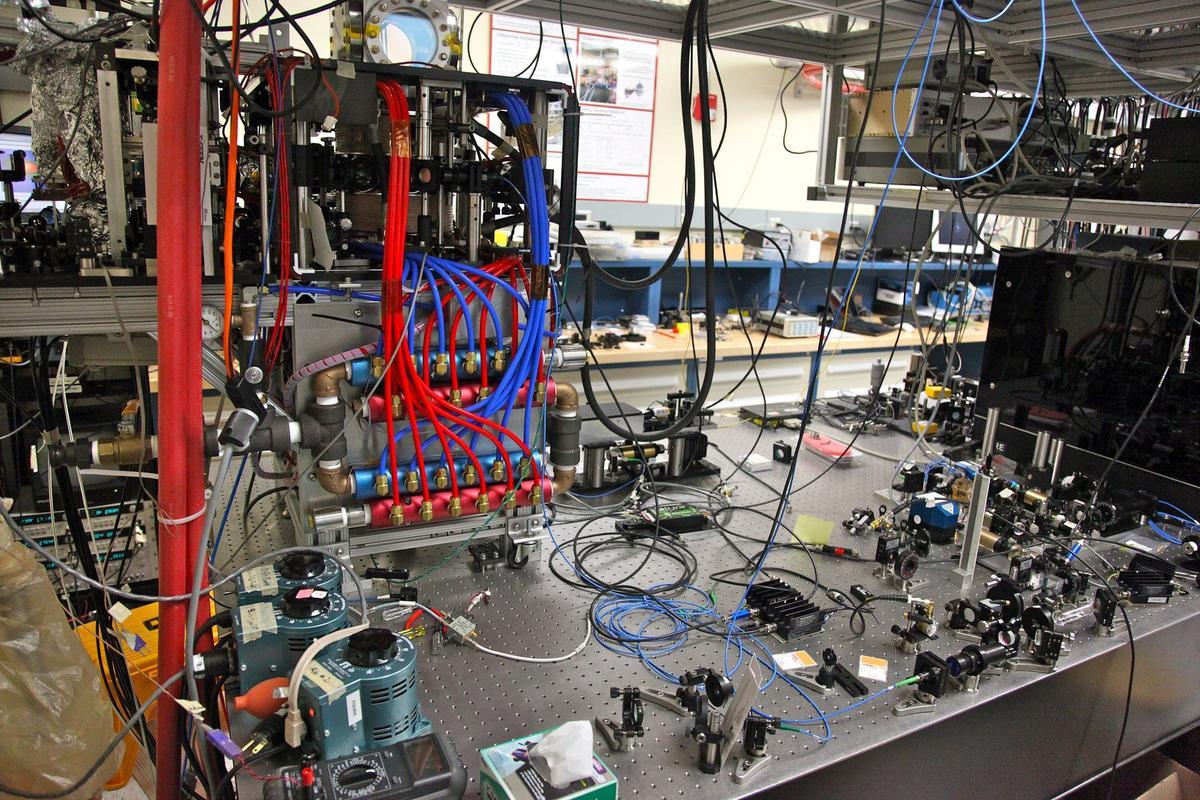
Groundbreaking experiment with ultrafast atoms confirms Albert Einstein’s predictions in the quantum world, measuring freefall with unprecedented precision without deciphering gravity’s nature.
A new frontier of advanced science has just brought quantum physics and general relativity together. International researchers have subjected Albert Einstein’s gravitational theory to rigorous testing on an atomic scale.
Using atoms of the element rubidium cooled to temperatures near absolute zero, scientists directly measured the quantum phase associated with freefall motion. The result showed complete alignment with the classical equivalence principle.
Published in the prestigious journal Science Advances, the study brought together experts from Ben-Gurion University of the Negev, the University of Ulm, and the University of Oxford, with the participation of Nobel laureate in Physics Roger Penrose.
The Technology Behind the Quantum Test
The team developed a system called the Galileo Quantum Interferometer to manipulate the wave-like nature of matter with unprecedented control.
Rubidium atoms were cooled to extreme limits, reducing thermal agitation and allowing the isolation of the sample’s quantum properties for high-precision measurements.
The atom’s quantum wave was placed in superposition and split into two paths: one remained suspended by magnetic forces, while the other entered freefall.
Interferometry and Einstein’s Principle
Upon recombining the separated paths, the phase difference in the interference pattern revealed the exact gravitational impact predicted by relativity.
The experiment reinforces the robustness of the equivalence principle in the microscopic domain, demonstrating that acceleration and gravity affect matter in the same way.
Regarding the distinction between affecting matter and proving the nature of the force, the study highlights:
Showing that gravity influences an atom described by quantum mechanics does not mean demonstrating that the gravitational field itself has quantum properties.
The Next Steps in Modern Physics
To demonstrate whether gravity possesses a truly quantum nature, future experiments will need to identify discrepancies between classical and quantum models.
The researchers’ current goal involves applying atomic interferometry to objects of greater mass, such as nanodiamonds, observing whether quantum superposition is sustained.
This advancement consolidates ultra-sensitive measurement tools, promising to drive the creation of extremely precise gravitational sensors in the future.
Although the great mystery surrounding the unification of fundamental forces remains unanswered, the experiment builds a solid bridge between the physics of the microcosm and the mechanics of the cosmos.
Mastering these atomic manipulation techniques paves the way for new tests of spacetime and the development of advanced instrumentation in the deep tech sector.