
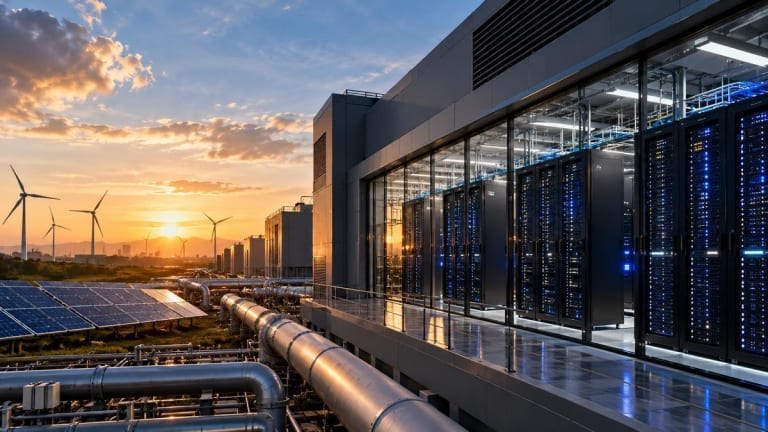
A strong business coalition is urging the federal government to urgently regulate Redata, placing natural gas and clean energy at the center of the debate over the future of data centers in the country.
The global race for digital infrastructure and artificial intelligence has placed Brazil before a strategic challenge: supplying massive data processing centers without destabilizing the national power grid. A powerful coalition formed by 32 business entities and nine parliamentary fronts recently sent a letter to President Luiz Inácio Lula da Silva, demanding the immediate regulation of Redata, the Special Taxation Regime for Datacenter Services.
The legislation, signed into law in September 2026 via Law No. 15,504, promises to boost the national tech sector, but remains stalled in bureaucracy. The main obstacle lies in defining complementary rules capable of unlocking billions in foreign and domestic investments aimed at cloud computing and advanced data storage.
The Energy Impasse and the Role of Natural Gas
The continuous operation of servers and cooling systems requires a massive volume of electricity, raising discussions over the most appropriate supply matrix. While the international market seeks alternatives such as the geothermal energy used by Google in the United States, the Brazilian business community advocates for so-called technological neutrality.
The coalition’s proposal includes the use of renewable sources such as solar, wind, hydroelectric, biomass, and biogas, but also opens space for natural gas. While fossil fuel advocates argue that it guarantees grid stability during times of low wind or solar generation, environmentalists and critical sectors point to the conflict with decarbonization goals.
Regulatory uncertainty harms financial planning and compromises the predictability needed to attract new investments directed toward Brazilian digital infrastructure.
Taxation and Structural Challenges
Beyond electricity supply, the dispute involves fiscal barriers and restrictions on the importation of advanced technological components. Companies warn that overly rigid lists of favored equipment could stall project implementation, harming Brazil‘s competitiveness compared to other global markets.
The group is also pressuring the federal government to negotiate with states, through Confaz, regarding tax alignment related to ICMS. The central concern is to prevent the extra costs of power grid expansion and transmission from being passed on to regular consumers, thereby protecting residential and industrial tariffs.
The outcome of this clash will determine Brazil‘s ability to establish itself as a regional hub for technology and artificial intelligence. Reconciling the voracious appetite for electricity from new data centers with energy security and the transition to sustainable sources remains the primary test for the future of clean energy in the country.