
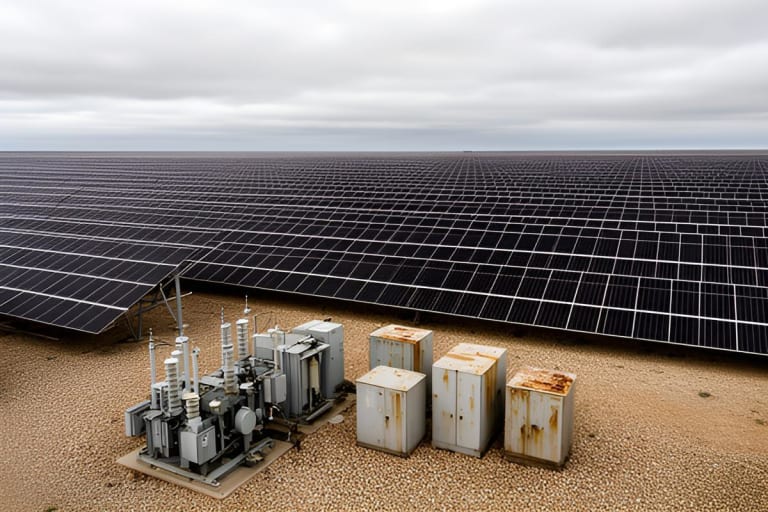
Financial distress and record debt in distributed energy generation are driving a wave of acquisitions by major investment funds in Brazil.
Brazil’s solar energy market is experiencing a profound turnaround. What began as rapid expansion, fueled by tariff incentives and falling prices for Chinese equipment, has run into severe debt issues.
With revenues failing to keep pace with financial obligations, the distributed generation segment has entered a turbulent period, opening the door for asset managers to go shopping for strategic assets.
This model has allowed homes, businesses, and small power plants to inject clean electricity into the traditional grid, making photovoltaic power the second largest source in the national electrical matrix, behind only hydroelectric plants.
However, the pace dictated by the regulatory timeline of Law 14,300 outpaced the actual capacity to acquire and retain consumers. The result was a disorderly rush for projects, oversupply, and price wars that squeezed company margins.
The Gold Rush and Oversupply
Between 2018 and 2022, expansion occurred in a controlled manner. However, the approval of the legal framework established deadlines for the gradual reduction of subsidies for credit compensation, triggering a true gold rush.
Investors and new market entrants rushed the construction of power plants to secure the most advantageous rules through 2045, ignoring the long-term dynamics of demand.
With installed capacity jumping from 9 GW in 2021 to a striking 45 GW, the market suffered from a lack of synchronization between the supply of megawatts and customer acquisition.
Aggressive competition reduced unit revenues, while fixed operating costs and high Selic interest rates eroded cash reserves.
Financial stress became evident in cases like Pontal-Thopen and Órigo Energia, whose financial expenses exceeded their annual net revenue.
The Infrastructure Fund Movement
Faced with this scenario of forced restructuring, major asset managers saw a prime opportunity to consolidate the sector. The prevailing thesis is that the demand for competitive electricity will continue to grow, benefiting those who already hold structured portfolios.
Vinci Partners, for example, used its climate impact fund—with anchor funding from BNDES—to acquire half of Faro Energy, betting on companies with balanced balance sheets and long-term corporate contracts.
José Guilherme Souza, partner at Vinci Compass, stated:
This inventory doesn’t die and this energy has a very competitive value.
Along the same lines, Suno Asset transformed its real estate investment fund focused on the sector into its primary vehicle.
The SNEL11 vehicle shifted its initial strategy of building new units to acquiring ready-to-operate plants from indebted companies or owners who prefer to transition into unit holders.
With plans to drastically expand its capacity in the coming months, the asset manager demonstrates how structured capital perceives resilience in the secondary renewables market.
The future of distributed generation will require rigorous regulatory adaptation, especially with Aneel discussions regarding new rules to curb grid oversupply and potential curtailments of energy injection.
Despite regulatory and macroeconomic challenges, the sector is moving toward a phase of greater maturity, where consolidation in the hands of capitalized players is expected to set the tone for Brazil’s energy transition in the coming years.