The board of directors of Assiferto RS visited Ecocitrus, in Montenegro, to experience firsthand a successful circular economy model that transforms organic waste into inputs, energy, and biofertilizers for sustainable agriculture.
The search for more efficient and sustainable solutions in agribusiness has found an important convergence point in Rio Grande do Sul. Recently, the board of Assiferto RS (Association of Organic Fertilizer Industries of Rio Grande do Sul) visited the headquarters of Ecocitrus, in Montenegro, a national benchmark in waste treatment and the implementation of a robust and effective circular economy.
The meeting, held on September 30, allowed the delegation to explore a complete ecosystem that integrates composting, anaerobic digestion, and the production of high-quality fertilizers. This model, which directly connects waste management to family farming, is a practical example of how to turn environmental liabilities into productive assets.
The power of the circular economy applied to the field
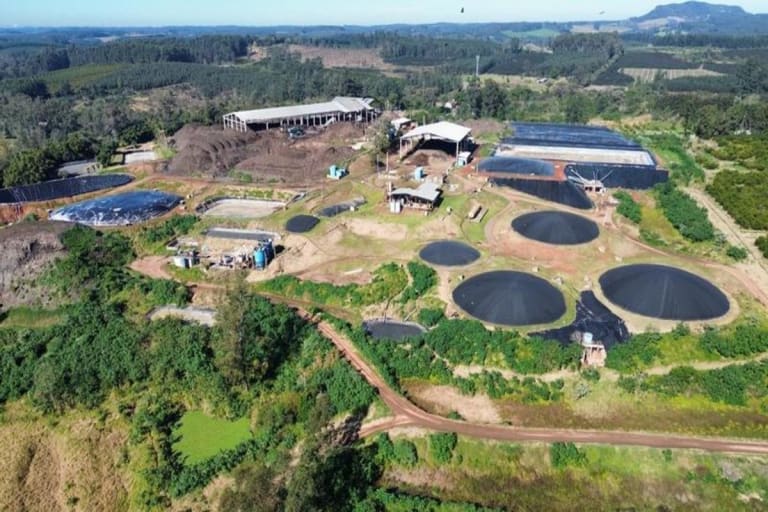
Since 1995, Ecocitrus has developed a structure that evolved from local producers’ need to obtain fertilizer for their orchards into a complex that currently serves more than 150 companies in Rio Grande do Sul. Using aerobic and anaerobic processes, the cooperative processes a vast range of materials, consolidating a cycle where waste returns to the soil in the form of compost and biofertilizer.
With seven biodigesters operating at full capacity and a treatment capacity of 12,000 cubic meters per month, the initiative demonstrates that proper management of organic materials is the path to increasingly sustainable production.
Valdecir Ferrari, president of Assiferto RS, stated:
It is a very concrete example of how we can view waste not just as something that needs to be treated, but as a source of inputs for new production processes. This concept is directly related to what we defend as an organization, which is the development and qualification of solutions for the proper utilization of organic materials.
Exchange of experiences and strengthening the sector
The visit also served as a forum for dialogue on the technical and regulatory challenges that companies in the organic fertilizer sector face on a daily basis. For Ernesto Carlos Kasper, founding partner and member of the Board of Directors of Ecocitrus, this exchange is essential for the maturation of the market.
Ernesto Carlos Kasper stated:
Hosting Assiferto is important because it brings together those who face the same technical and regulatory challenges. This exchange strengthens the entire organic fertilizer sector and helps show that waste, when properly treated, returns to the soil as a quality input.
In addition to waste management, the cooperative plans to expand its reach, aiming to include producers from other regions, such as Canguçu and São Lourenço, offering technical support for the transition to organic agriculture. With more than 130 members and a diversified production ranging from citrus cultivation to industrial processing, Ecocitrus proves that economic viability can go hand in hand with environmental responsibility.
The integration between Assiferto RS and models like Ecocitrus signals a promising future for the bioeconomy in the state. As the clean energy and soil nutrition sector evolves, the dissemination of these sustainability practices becomes essential to ensure food security and the recovery of soil health in Rio Grande do Sul, consolidating a productive cycle that respects the limits and needs of the environment.