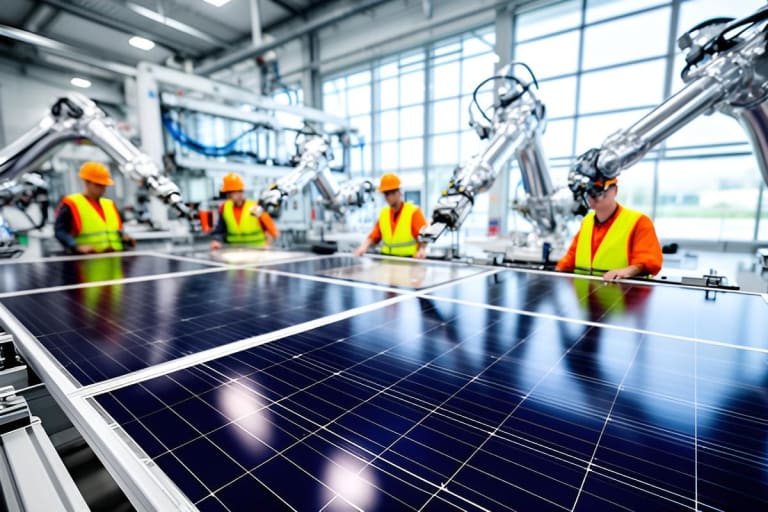
The technological race for “tandem” solar panels promises to increase energy efficiency by 25%, placing the U.S. in a fierce competition for industry leadership against Chinese dominance.
Photovoltaic manufacturers in the United States are on the verge of unveiling an innovation that could shift the power balance in the global renewable energy market. The focus is on tandem solar panels, a multi-layer technology capable of converting significantly more solar radiation into electricity than traditional silicon-based panels. If successful, this technology will allow power plants and homes to generate substantially more energy while occupying less space.
The strategy of American companies is clear: to overcome the hegemony of China, which currently controls approximately 80% of the global solar supply chain. Companies like Tandem PV, First Solar, and Hanwha Qcells are at the forefront of development, seeking not only superior efficiency but also the durability required to convince investors and banks that the energy transition will not be compromised by premature maintenance costs.
The durability challenge and a conservative market
Despite technical optimism, the power sector remains cautious. To be viable at scale, the new technology must prove it can withstand decades of exposure to extreme climates, from scorching desert heat to hail storms. Consequently, manufacturers have been subjecting their products to rigorous laboratory testing, simulating impacts and intense thermal variations.
Fabian Fertig, director of research and development at Qcells in Germany, stated:
“We have been focusing on stability. We need to convince the banks that this new technology is capable of performing.”
Economic impact and the price barrier
Cost remains a significant hurdle. Currently, tandem panels can be up to three times more expensive than conventional single-layer models. This price gap is the primary advantage of Chinese manufacturers, who have the scale to offer products at unbeatable prices. However, advocates of the technology argue that the 25% increase in efficiency justifies the initial investment, especially given the rising demand for electricity driven by data centers and the advancement of Artificial Intelligence.
The future of the energy mix
Integrating more efficient panels with storage systems promises to boost the capacity factor of solar power plants, bringing them closer to the levels seen in baseload sources, such as natural gas plants. With the support of industrial policies aimed at revitalizing American manufacturing—such as Hanwha‘s billion-dollar investments in Georgia—the expectation is that the United States will be able to reclaim a leading role in high-tech manufacturing.
The viability of tandem panels will ultimately be tested by the market. As the next steps involve extensive third-party testing to ensure reliability, the industry is watching closely to see if the promised efficiency will be enough to overcome logistical challenges and fierce international competition, redefining the role of solar power in the global energy mix over the coming years.