
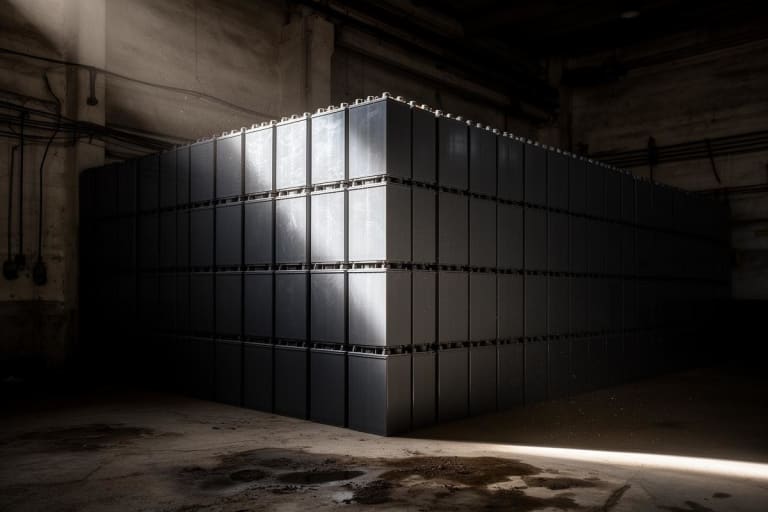
Brazil is preparing for its first capacity reserve auctions focused on batteries, promising to transform the energy sector and establish storage as a vital new infrastructure.
The large-scale Brazilian battery market is reaching a decisive stage with the proximity of the anticipated capacity reserve auctions. Scheduled for December 2026, these competitive bids represent a landmark, mobilizing manufacturers, integrators, financial institutions, and investors in a move that will redefine the dynamics of Brazil’s energy mix. The primary objective is to secure quickly deployable power, offering crucial support to the National Interconnected System (SIN).
The major innovation lies in the model: instead of generating new energy, batteries store electricity during periods of high supply and reintroduce it into the grid when demand or operation requires. This capability establishes a new economic avenue, transforming storage into a long-term contracted infrastructure, essential for a system increasingly reliant on variable renewable sources such as solar and wind energy.
Decisive Auctions and Defined Deadlines
ANEEL confirmed December 2 and 4, 2026, as the dates for the competitive bids. One will target systems with national content requirements, while the other will allow broader participation, according to the tender rules. Contracts will have a 15-year duration, with supply scheduled to begin on August 1, 2028. This offers investors a long-term revenue benchmark but demands rigorous planning in financing, supply, and grid connection.
The schedule released by BNDES for the LRCAP 2026 details the approval of the tender for October 27 and its publication for October 29. Registrations will take place in November, preceding the auction sessions in December.
Incentive for National Industry and Innovation
The modality prioritizing local content is a strategic bet for the country’s industrial development. It places manufacturers and suppliers seeking accreditation and productive presence in Brazil at a competitive advantage, stimulating assembly, engineering, control software development, and integration services.
BNDES is already mapping several companies, from different origins, that are seeking accreditation for the supply of systems and batteries, indicating fierce competition not restricted to a single player.
The advent of large-scale storage is not just a technological addition; it’s a paradigm shift that strengthens the resilience and flexibility of our electric grid.
The Strategic Role of Grid Storage
A grid-scale energy storage system goes far beyond battery cells or containers. It involves converters, advanced energy management systems, electrical protection, complex integration, and continuous operation for many years. For intermittent renewable sources, such as solar generation that peaks during the day and rapidly declines at dusk, batteries become a vital mechanism to shift energy and provide power services, smoothing fluctuations and ensuring stability.
While batteries may not solve all grid challenges, they add a high-value operational tool. For investors, viability will depend on factors such as the contracted price, equipment cost, financing structure, battery degradation, and capacity replacement. A successful project needs to maintain its economic attractiveness even after years of intense charge and discharge cycles.
Future Impact and Next Steps
For manufacturers and integrators, the timeline establishes a race for certification, proof of local content, robust guarantees, and delivery capability. For the Brazilian electric system, the test will be the projects’ effective response capacity, generating the expected gain in reliability.
The December 2026 auctions do not end the discussion but open a new chapter. They establish a fundamental benchmark for a market with substantial growth potential as Brazil integrates more renewable sources and needs to operate an increasingly dynamic energy mix. Therefore, detailed monitoring of the tenders, negotiated prices, and winning projects will be crucial to measure the true impact and size of this nascent storage value chain in the country.