
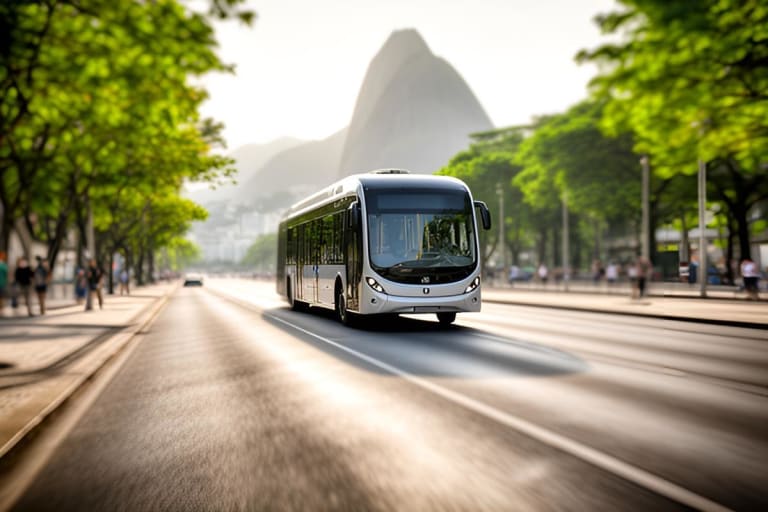
BNDES Releases R$329 Million for 175 Electric Buses in Rio de Janeiro, Boosting Sustainable Mobility and Emission Reduction in the Fluminense Capital.
The National Bank for Economic and Social Development (BNDES) has confirmed the approval of a substantial R$329 million financing package for the Fluminense capital. This amount will catalyze an ambitious project to electrify the urban bus fleet in Rio de Janeiro, an initiative poised to transform urban mobility and air quality in the city. The move represents a significant step towards energy transition in the public transport sector, aligning the metropolis with global sustainability trends.
The financing, sourced from the Climate Fund, underscores Brazil‘s commitment to green infrastructure development. The public-private partnership, structured as a 16-year concession, aims not only to acquire 175 new electric buses but also to install and operate all necessary charging infrastructure. This is a strategic move to consolidate a cleaner and more efficient transport ecosystem in the “marvelous city.”
A Cleaner Future for Carioca Transportation
The initiative represents a total investment exceeding R$500 million. Rio de Janeiro’s Municipal Secretary of Transportation, Jorge Arraes, detailed that the total R$509 million includes the BNDES contribution, funds from the partner concessionaire, and a matching contribution from the municipality. This robust financial structure highlights the seriousness and scope of the project, which is fundamental to Rio de Janeiro‘s long-term sustainability vision.
The environmental impact projections are notable. An estimated annual reduction of 13.3 thousand tons of carbon dioxide equivalent (CO₂e) is expected. Over the 16 years of operation, this will accumulate to a decrease of approximately 199.4 thousand tons of CO₂ equivalent. These figures underscore the project’s crucial role in climate change mitigation and improving the quality of life for Rio’s residents.
Commitment to Global and Local Goals
This project fully aligns with the municipal urban mobility plan, which aims for a bus fleet with 20% zero-emission vehicles by 2030. This ambitious goal translates to the integration of approximately one thousand electric buses into the city’s public transport system.
The electrification of transport will substantially contribute to meeting the goals set by the Paris Agreement, in addition to offering a tangible improvement in the transportation experience for city passengers.
Luciana Costa, Director of Infrastructure, Energy Transition, and Climate Change at BNDES
The Mayor of Rio de Janeiro, Eduardo Cavaliere, reinforced the modernization plan, stating that fleet renewal will be an ongoing process, integrating both electric buses and those powered by biofuel. This multifaceted approach ensures a more resilient and adaptable energy transition for the city’s transportation system.
The injection of capital from BNDES into Rio de Janeiro’s bus electrification project is a milestone for sustainable urban mobility in Brazil. By enabling the transition to zero-emission vehicles, the initiative not only positively impacts the metropolis’s environmental quality but also sets an important precedent for other cities in the country.
With the promise of cleaner, quieter, and more efficient transportation, Rio de Janeiro is making significant progress in its commitment to sustainability and the well-being of its citizens, paving the way for a future with lower emissions and more innovation in the clean energy sector.