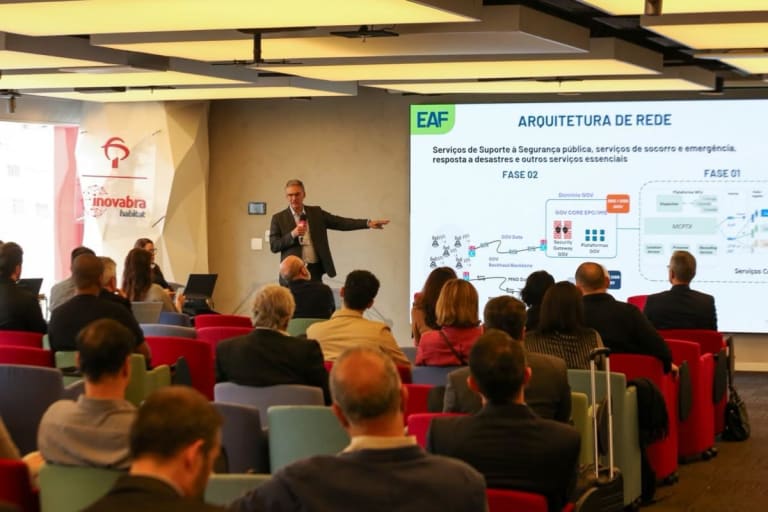
The expansion of the Private Mobile Network in Brazil is gaining strategic momentum through partnerships with telecommunications carriers. EAF emphasizes that the integration of infrastructure will ensure security and reach for public safety forces.
The success of the implementation and national expansion of the Public Administration’s Private Network depends directly on strategic collaborations with telecommunications carriers. This was the core message delivered by Geraldo Segatto, COO of the Entity for the Administration of the Frequency (EAF), during the MVNO Experience event.
According to the executive, in the model designed for the country, EAF will implement the network’s “brain”—with call processing and data storage in a dedicated core—while the reach of the partner carriers’ infrastructure will ensure energy and connectivity coverage throughout the national territory.
Security and mission-critical technology
The security of this collaborative ecosystem is rigorous. Data travels fully encrypted from end to end—from the application to the dedicated core—ensuring absolute information protection.
All user intelligence and data are centralized, a non-negotiable technical premise for the mission-critical Private Mobile Network.
The integration of public safety, emergency, and defense agencies is already a reality in the Federal District. The infrastructure available to agencies such as the Military Police (PMDF), legislative police, and Armed Forces is ready to operate via the MCx mission-critical platform.
Geraldo Segatto highlighted:
The project adopted the SMVNO (Secure MVNO) model, which incorporates extra layers of security, traffic control, and specific gateways, perfectly meeting the requirements of police and emergency teams.
Priority in critical events
One of the major technological differentials highlighted by Geraldo Segatto is the activation of QPP (Quality of Service, Priority, and Preemption) on the carriers’ power and access networks. This feature ensures that security forces have absolute priority in using the mobile data network, even in locations with high concentrations of commercial users.
When assessing the future of the project, EAF revised its initial strategy, which originally planned for the construction of its own network, to adopt the principle of cost-effectiveness. By utilizing existing MVNO (Mobile Virtual Network Operator) infrastructure, the project gains scalability and financial viability to expand rapidly across other Brazilian states, boosting communication efficiency between defense institutions and the sustainability of technology investments.