
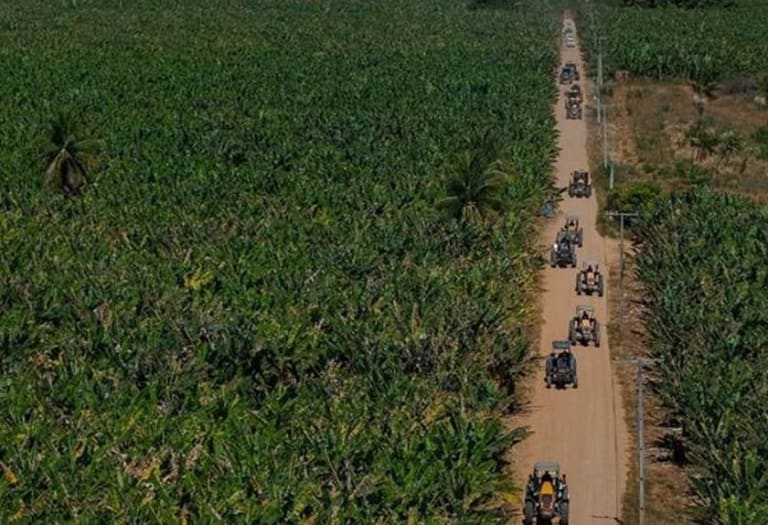
The 5th edition of the “Caminhos do Oeste Baiano” journey reveals how technology and new management practices are transforming the Formoso Irrigation Project into a national benchmark.
The “Viajando com V de Valtra” (Traveling with V for Valtra) expedition concluded its tour of Western Bahia this Sunday (20), with a strong focus on field modernization. The fleet of 14 tractors arrived at the Formoso Irrigation Project, located in Bom Jesus da Lapa, one of the most important pillars of fruit production in the state.
The site not only sustains an annual harvest of over 200,000 tons of bananas but also holds the Geographical Indication (GI) seal from the INPI (National Institute of Industrial Property). This certification is a strategic advantage for distribution, increasing the product’s added value and ensuring that the sector continues to expand its reach in both domestic and international markets.
Technology and efficiency as production allies
The main topic of this technical visit was the technological adaptation required to face the current challenges of agriculture. The transition to the use of compact tractors has proven crucial for optimizing work on the terrain.
These machines, specifically designed to operate between crop rows, have solved two historic bottlenecks: labor shortages and the need to reduce waste of inputs. Beyond agility, the modernization of equipment promotes more conscious fuel consumption, making operations more sustainable and economically viable.
Specialized mechanization at the Formoso Irrigation Project demonstrates that innovation is the only path toward the long-term viability of family and commercial farming in the region.
Social impact and economic diversification
The significance of the hub extends far beyond crop numbers. Managed by Codevasf, the project serves as an engine for social development, housing 800 producers and driving a supply chain that supports 20,000 direct and indirect jobs in Bahia.
The strategy now is to move beyond dependency on a single crop. Incentives for planting oranges and other supporting crops aim to strengthen the region’s production matrix, which has historically been heavily tied to grain monoculture and cotton. With this diversification, Western Bahia is preparing for a future with greater economic resilience and reduced vulnerability to market fluctuations affecting major commodities.