
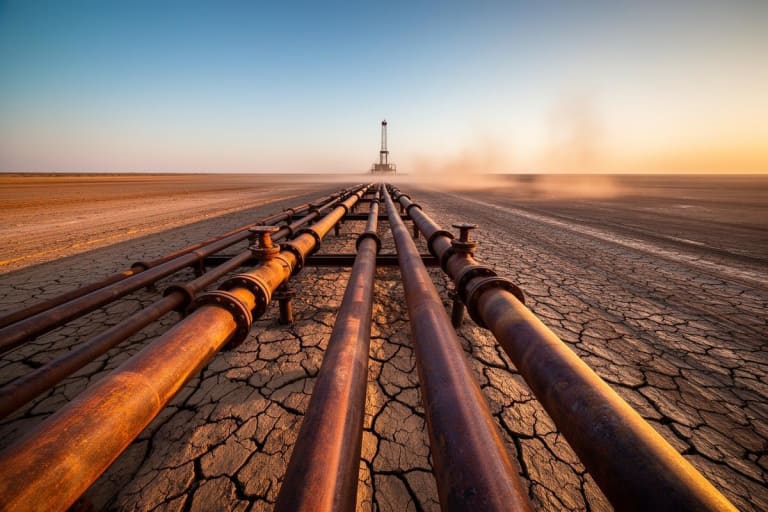
Brazil’s Superior Court of Justice (STJ) is deliberating on hydraulic fracturing, or fracking, potentially shaping the future of unconventional oil and gas reserves and impacting the environment and the economy.
This Wednesday, a crucial decision by the Superior Court of Justice (STJ) could reshape Brazil’s energy landscape. Under consideration is the use of hydraulic fracturing, commonly known as fracking, for the exploration of unconventional oil and natural gas reserves. The hearing, led by the First Section with Justice Afrânio Vilela as rapporteur, will determine the conditions – or prohibition – for this controversial technique in the country.
The significance of this deliberation is immense, touching upon issues of economic development, energy security, and environmental sustainability. The approval or restriction of fracking could open new frontiers for energy resource production or strengthen the protection of ecosystems and aquifers.
Fracking Under Debate: Potential and Controversies
Hydraulic fracturing is a technique that has revolutionized the global oil and gas industry, boosting production in countries like the United States, Canada, and in the Vaca Muerta region of Argentina. However, its use is severely criticized by environmentalists who warn of the risk of soil and groundwater contamination, affecting aquifers.
In Brazil, the controversy is no less intense. Sectors of agribusiness and social movements strongly oppose the practice. There is even a bill (PL 1935/2019) pending in the Chamber of Deputies seeking to ban fracking. Additionally, various local, state, and municipal laws have already prohibited the activity, driven by the “Não Fracking Brasil” (No Fracking Brazil) coalition.
Proponents’ Arguments and Governmental Division
Conversely, oil and gas industry associations, such as Abpip and IBP, argue against a preemptive ban on the technique. They contend that each project should be evaluated individually based on rigorous technical, environmental, and regulatory criteria, and that there are no technical or environmental grounds for a generalized prohibition.
A spokesperson for the IBP, defending case-by-case evaluation, stated:
We believe that an indiscriminate ban on hydraulic fracturing limits Brazil‘s potential to diversify its energy matrix and attract investment, especially for natural gas, which plays a crucial role in the transition. Each project must be assessed individually with technical and environmental rigor.
Interestingly, the current government also appears divided. The Minister of Mines and Energy, Alexandre Silveira, has publicly criticized attempts to ban fracking, while the Ministry of the Environment expresses caution, indicating that the technique does not align with the country’s long-term vision for sustainability.
The Legal Path in the STJ
The discussion at the STJ is being addressed through an Incident of Assumption of Competence (IAC), an instrument aimed at establishing a binding understanding. This means the final decision will serve as a mandatory precedent for a series of lawsuits currently pending in the country.
Three central points are under debate: the necessity of an Environmental Assessment of Sedimentary Areas (AAAS) before block tenders, the adequacy of the current regulation by the National Agency of Petroleum, Natural Gas and Biofuels (ANP), and the definition of responsibilities for environmental licensing – whether by Ibama or state agencies – concerning risks to aquifers.
The case originated from the 12th ANP Bid Round in 2013, which offered blocks with potential for unconventional gas, triggering a lengthy process of legal disputes that now culminates at the STJ.
The STJ‘s verdict will have a profound impact on Brazil‘s energy policies and environmental legislation. By defining the limits for hydraulic fracturing, the Court will not only determine access to potential new sources of oil and gas but also reaffirm the country’s commitment to protecting its environment and sustainability.
The decision will guide the future of energy resource exploration in Brazil, balancing the pursuit of development with the imperative safeguarding of ecosystems and communities.