
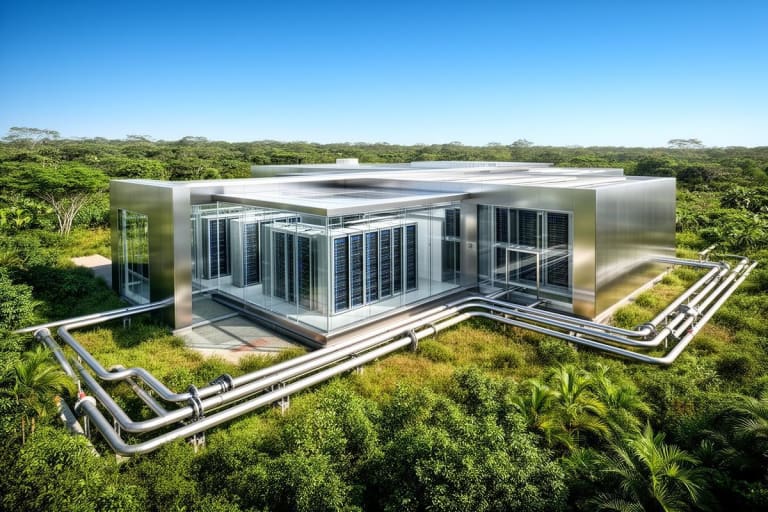
Legislative progress for data centers paves the way for natural gas, a move championed by Minister Alexandre Silveira.
Brazil’s energy landscape is undergoing a strategic redefinition, driven by the surging demand for digital infrastructure. The Minister of Mines and Energy, Alexandre Silveira, has voiced strong support for including natural gas as a primary power source for the country’s burgeoning data center market. This endorsement arrives at a critical juncture, following significant amendments to the sector’s regulatory framework.
The flexibility introduced by the Senate regarding the Special Tax Regime for Data Center Services (Redata) is viewed by the minister as a substantial step forward. The new regulation, which deviated from the original proposal presented by the Chamber of Deputies, now permits the use of energy sources classified as “renewable or low-emission”—a strategic shift that broadens the options for expanding digital infrastructure in Brazil.
Redata flexibility and the inclusion of natural gas
The fuel source for data center expansion has been the subject of intense legislative debate. Initially, the proposal from the Chamber of Deputies required that 100% of the energy consumed by these facilities come from strictly “clean or renewable” sources. However, the version enacted by the Senate introduced a key nuance by allowing “renewable or low-emission” sources. As noted by Minister Alexandre Silveira, this change is fundamental for the sector’s development.
The formal definition of “low-emission” will be determined by the federal government, taking into account environmental impacts and greenhouse gas emissions. This flexibility opens doors not only to renewables but also to nuclear energy and, significantly, natural gas, aligning with the minister’s strategic vision.
The minister’s strategic view on natural gas
Alexandre Silveira makes no secret of his stance as a “proponent of natural gas.” He highlights that the approval of Redata is a crucial milestone for making large-scale data centers viable in Brazil, positioning natural gas as an essential element of this transition. The minister points to the United States as a model, where 6.5 GW of gas-fired thermal generation is currently being developed specifically to meet the energy demand of data centers, proving the scalability and viability of this solution.
Furthermore, the minister emphasized the need for strategies to lower the cost of natural gas in the Brazilian market, increase domestic production, and explore unconventional reserves, including the potential for fracking. He argues that since Brazil imports gas derived from US fracking, it cannot afford to overlook its own reserves, framing gas as a vital transition fuel for energy security and industrial growth.
The role of the STJ and the future of fracking
The debate surrounding unconventional gas exploration, particularly fracking, reaches a turning point with a pending ruling by the Superior Court of Justice (STJ). On September 9, the Court is set to determine if and under what conditions the exploration of unconventional oil and gas will be permitted in Brazil. The decision will have a direct impact on natural gas supply strategies and the country’s potential energy autonomy, directly influencing the availability of “low-emission” energy sources for sectors such as data centers.
Minister Alexandre Silveira‘s defense of natural gas, within the context of Redata‘s flexibility, signals a paradigm shift in Brazilian energy policy. The goal is to balance technological advancement and the growing demand for digital infrastructure with the search for efficient energy sources, while acknowledging the strategic role of fuels like natural gas in energy security and supply for ambitious data center projects.