
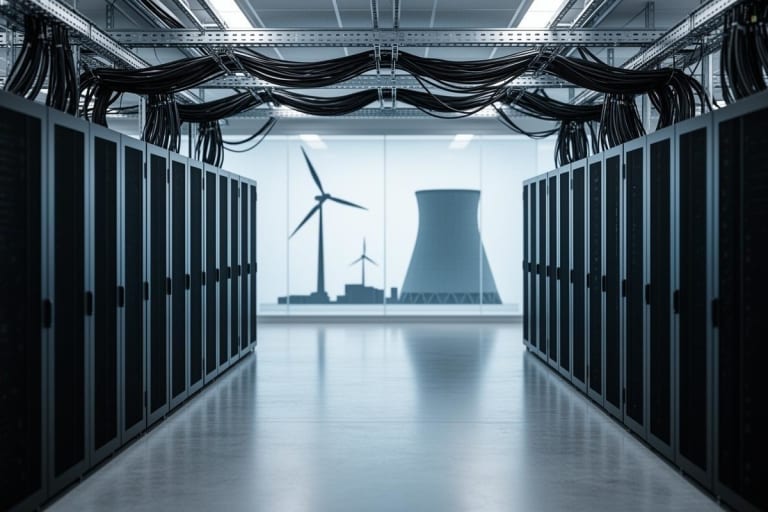
The Senate approved Redata, a tax regime incentivizing the installation of data centers in Brazil, opening strategic doors for firm energy sources like nuclear and biogas.
The recent approval of the Special Tax Regime for Datacenter Services (Redata) by the Federal Senate marks a significant turning point for Brazilian digital infrastructure. The bill, reported by Senator Cid Gomes (PSB/CE), received crucial adjustments that broadened the scope of permitted energy sources to power these facilities, shifting from an exclusive requirement for “renewable” sources to “renewable or low-emission” ones.
This alteration sets a decisive precedent for the energy sector by including technologies capable of providing constant baseload power—essential for the uninterrupted operation of high-performance data centers. With the exponential growth of Artificial Intelligence (AI), the demand for energy that is not subject to intermittency has become the main bottleneck for the expansion of the data processing market in the country.
Opportunity for Firm Energy and Decarbonization
For the Brazilian Association for the Development of Nuclear Activities (Abdan), the legislative change aligns Brazil with global powerhouses that already integrate atomic energy into their technological ecosystems. Nuclear energy is presented as a highly reliable solution meeting the standards required by major global operators.
Celso Cunha, president of Abdan, points out:
The large data centers powering the artificial intelligence revolution need reliable, continuous, and low-carbon emission energy. This is precisely where nuclear energy excels.
Simultaneously, the biogas and biomethane sector celebrates the increased flexibility. The Brazilian Association of Biogas (ABiogás) highlights that the source combines sustainability with supply security, enabling the utilization of waste and the reduction of methane emissions, while delivering dispatchable generation indispensable for 24/7 operations.
Tax Impact and Next Steps
Redata foresees tax relief on federal taxes for the import of technological equipment, with an estimated fiscal waiver of billions of reais in the coming years. In return, companies must meet stringent requirements, such as water efficiency in cooling systems and local investment targets.
The focus of the associations now turns to the project’s regulation, which will be essential to detail which sources will be classified as “low-emission.” Both Abdan and ABiogás seek explicit recognition in the regulation to ensure technological neutrality and security for investors.
Furthermore, Brasscom, representing the technology sector, emphasizes that the measure still requires a complement through Confaz to reduce state-level ICMS (Value Added Tax) on equipment. With the deficit in the digital services trade balance on an upward trajectory, the expectation is that this set of policies will transform Brazil into a regional technological hub, reducing dependence on imported computing power and attracting large-scale investments to national soil.