
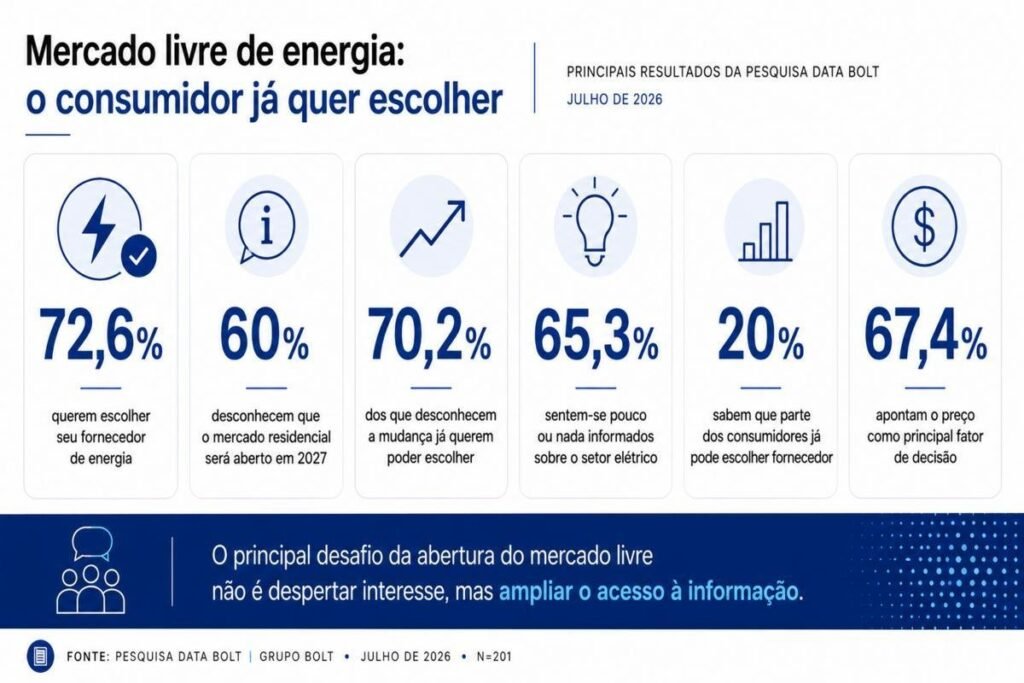
72% of consumers are eager to switch to the free energy market, driven by the desire for savings, finds a survey by Bow-e.
With electricity bills increasingly impacting inflation and rising at rates exceeding the IPCA, consumers are actively seeking alternatives to cut costs. A new survey by Bow-e, a distributed generation company under the Grupo Bolt umbrella, reveals high interest in migrating to the free energy market, with an impressive 72.6% of respondents expressing a desire to choose their own power supplier.
However, the findings highlight a paradox: while the drive to save money is clear, knowledge of how the system works and the access rules remain limited. This gap between the desire for choice and a lack of information is a critical issue that must be addressed for the opening of the free market to be successful.
The Desire for Choice Ignores Regulation
The Bow-e survey indicates that a significant portion of consumers, approximately 60%, is unaware of the planned opening of the free energy market to the residential segment in 2028. Surprisingly, even among this uninformed group, 70.2% express a desire to be able to exercise this option now. This demonstrates pent-up demand for autonomy in energy procurement.
“The data shows that there is spontaneous demand for freedom of choice even before the consumer is aware of the regulatory shift,” says Ciro Neto, CEO of Bow-e.
He highlights that the industry’s challenge will not be sparking interest, but rather expanding access to information. The goal is for consumers to understand how the free market works so they can make informed decisions once the official opening takes place.
Lack of Awareness Extends to Current Rules
The study also reveals a gap in the understanding of existing electricity sector rules. 37.9% of respondents believe that the ability to choose an energy supplier is restricted to large companies and industries. Only 20% of consumers are aware that this choice is already a reality in Brazil for certain consumption profiles.
This lack of familiarity with the free energy market is compared to the routines of other services. For 43.2% of participants, it is still not possible to switch energy suppliers as easily as changing a phone carrier or internet plan. This misconception contrasts with the reality that the transition to freedom of choice is already underway for many.
Savings are the Main Driver for Migration
In a climate of financial tightening, the deciding factor for migrating to the free market is, unsurprisingly, the tariff price. 67.4% of respondents cited cost savings as their primary criteria. Aspects such as customer service quality (11.6%), preference for renewable energy sources (7.4%), and benefit programs (7.4%) followed.
Ciro Neto emphasizes that while price is the initial lure, the consolidation of this new market will depend on companies’ maturity in offering more than just competitive rates.
“Price will naturally be the gateway to competition. But as the market matures, factors like service quality, transparency, and value-added services will become the determining factors for retaining these consumers in the free environment,” concludes the executive.
The Data Bolt survey, conducted between July 13 and July 24, 2026, with 201 respondents nationwide, seeks to measure consumer knowledge and perceptions regarding the free energy market and the future opening to the residential segment, highlighting the need for a joint effort to inform and empower consumers for this new energy era.